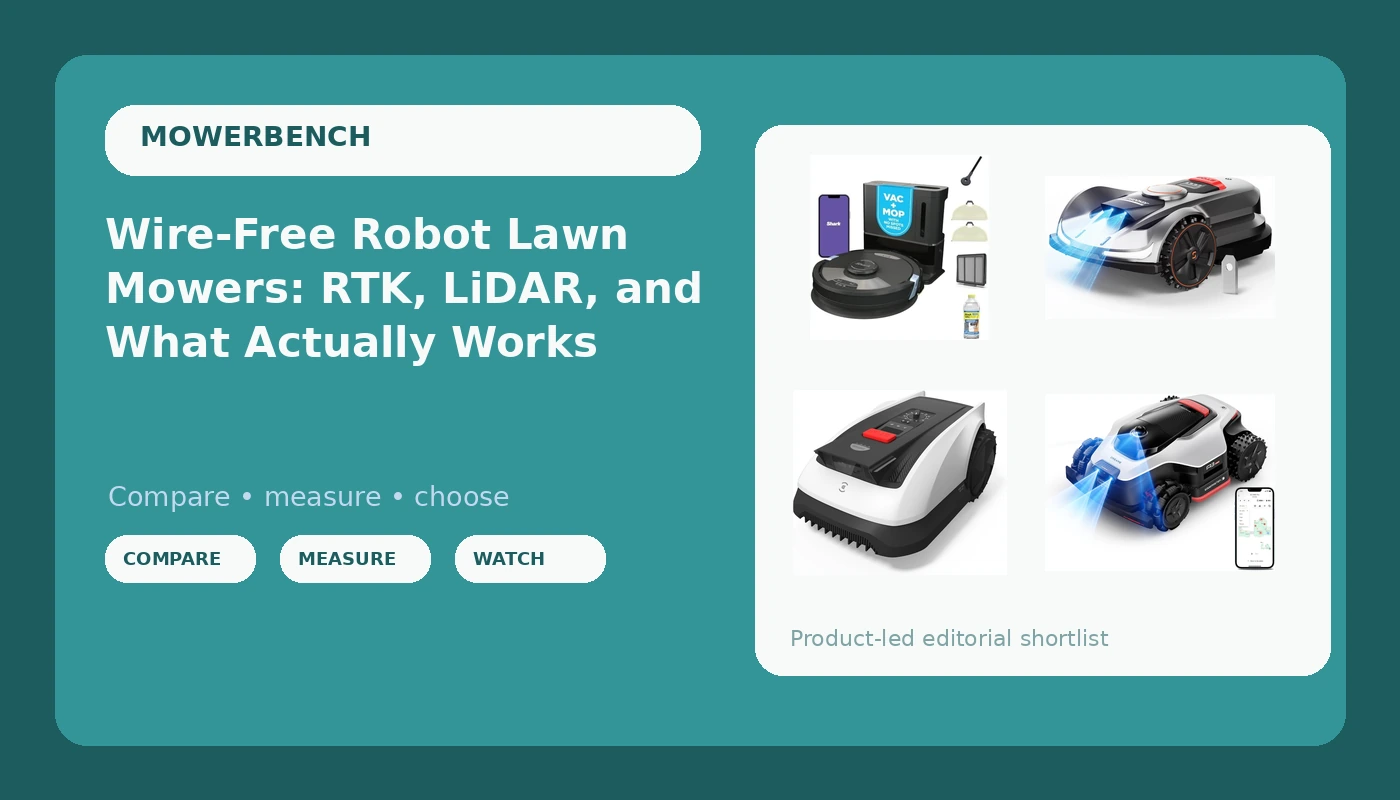
Every wire-free robot lawn mower makes the same promise: no perimeter wire, no trenching, no weekend spent stapling cable along the edge of the flower bed. That promise has largely come true, which is why so many homeowners now start their search with a wire-free robot lawn mower instead of a traditional wired install.
The problem is that "wire-free" is not one technology. It is two, and they fail in opposite conditions. RTK mowers fix their position by comparing satellite corrections against a fixed reference, which is precise under open sky and unreliable under a dense maple canopy. LiDAR mowers build a local map with a spinning laser, which works in shade but still has to be told where the lawn ends. Neither approach is wrong. They simply suit different lots, and the products below split along roughly those lines.
Related: Staking a Boundary Without Wire: Mapping Tips for RTK Mowers →
Quick answer
If your lawn has a clear view of the sky and sits under about a quarter acre, the ECOVACS Goat O1000 covers the essentials without a perimeter wire. For larger, more open properties, the Sunseeker X7 AWD is listed for lawns up to 0.75 acre and adds vision-based obstacle handling. If tree cover or tight geometry makes satellite positioning unreliable, the Dreame A3 AWD navigates with LiDAR instead. The Shark Matrix Plus is not a mower at all; it is a 2-in-1 robot vacuum and mop for the indoor floors the mower never touches.
Four useful options
| Model | Best fit | What stands out |
|---|---|---|
| (Upgraded) DREAME A3 AWD 1000 LiDAR Robot Lawn Mower, 45-Min Fast Charge | Yards with tree cover or narrow side passages | LiDAR navigation plus all-wheel drive and a 45-minute fast charge |
| Sunseeker X7 AWD Robot Lawn Mower, RTK, Vision AI, 0.75 Acre, Wire-Free | Larger, open properties up to 0.75 acre | RTK positioning with vision AI and an AWD chassis |
| ECOVACS Goat O1000 RTK Robot Lawn Mower, Perimeter Wire Free Vision Robotic Lawnmower for 1/4 Acres Lawn, Automated Mapping, APP Control, 3D Obstacle Avoidance, Zero-Edge Cutting | Suburban lots around a quarter acre | Wire-free RTK setup with zero-edge cutting and 3D obstacle avoidance |
| SharkMatrix Plus 2-in-1 Robot Vacuum & Mop, Black/Brass, AV2610WA | Indoor floors in the same household | A vacuum and mop in one unit, with its own dock and app |
The LiDAR all-rounder: (Upgraded) DREAME A3 AWD 1000 LiDAR Robot Lawn Mower, 45-Min Fast Charge
The trade-off with LiDAR is boundary definition. A laser tells the robot where solid objects are; it does not automatically know where your lawn stops and the neighbor's starts. In most LiDAR-first designs you walk the perimeter once with the mower or trace it in the app, and the machine stores that outline. That is still less work than burying wire, but it is not zero work, and it is the step buyers skip and then complain about. The second trade-off is slope behavior: all-wheel drive helps, but traction on a wet grade depends on tire condition and cutting height as much as on the drivetrain.
The large-lawn option: Sunseeker X7 AWD Robot Lawn Mower, RTK, Vision AI, 0.75 Acre, Wire-Free
RTK is only as good as its sky view, and on a large property the reference antenna placement becomes a design decision rather than an afterthought. Put the reference where buildings and evergreens crowd it, and the correction signal degrades across the whole lawn. Put it on a clear corner, and the mower holds a consistent line. The practical consequence is that a big open lot is exactly where RTK shines, while a wooded lot is exactly where it frustrates. Coverage rating and navigation technology are separate questions, and the X7 answers both with the same assumption: open ground, open sky.
The small-yard wire-free option: ECOVACS Goat O1000 RTK Robot Lawn Mower
A quarter acre is the classic suburban front-and-back combination, and it is where frequency beats raw capability. A machine in this class running daily keeps clippings short enough to disappear into the turf, which is the entire point of mulching. The zero-edge claim is worth understanding rather than trusting: it means the deck is designed to reach closer to borders than a deck with the blade set inboard, but no robot mower cuts flush against a wall, so you should still plan on trimming. The app is where this class of mower lives or dies. Mapping, no-go zones, and schedules all run through it, and a mower that loses its map is just a slow, heavy paperweight.
The indoor counterpart: SharkMatrix Plus 2-in-1 Robot Vacuum & Mop, Black/Brass, AV2610WA
Indoor and outdoor robots solve different problems with different sensors, and it is worth keeping them mentally separate. An indoor vacuum navigates rooms, thresholds, and furniture legs on a hard floor with tight tolerances. A mower navigates a soft, uneven, living surface that changes height every week. Buying both does not make them interoperate, and the maintenance rhythms differ too: mower blades and dock contacts versus vacuum brushes, filters, and mop pads. Treat them as two systems with two budgets.
Prices and availability may change. Product images, names, and retailer links are matched to verified listings. No current price, rating, stock status, or measured result is stated here without current evidence.
What RTK and LiDAR each do well
RTK stands for real-time kinematic, and it works by correcting satellite position against a fixed reference point. The result, under open sky, is repeatable accuracy measured in centimeters rather than meters, which is what lets a mower follow the same line every day without a wire. The failure mode is obstruction. Tree canopy, tall buildings, and deep valleys degrade the correction, and a mower that loses its fix will typically stop and wait rather than guess. If your lawn is ringed by mature trees, budget for the possibility that an RTK-only machine spends part of the season parked.
LiDAR works differently. A spinning laser measures distance to nearby objects and builds a map of the physical world, which is unaffected by leaves overhead. That makes it robust in shade, along fence lines, and in narrow side yards where satellite geometry is poor. What LiDAR does not do is identify the edge of your property. It knows a tree trunk is a tree trunk, but the boundary between lawn and mulched bed is a decision, not an object, so the outline has to come from you. The two systems are therefore complementary rather than ranked, and a hybrid machine that uses both is the direction the market keeps drifting.
Vision, which appears in both the Sunseeker and ECOVACS listings, is a third layer. Cameras classify what the laser or the satellite fix has already located, which is how a mower decides whether an obstacle is a garden hose it can cross or a hedgehog it should avoid. Vision is the layer most likely to improve through firmware updates, and it is also the layer most likely to behave oddly after one.
Match the machine to the lot, not the spec sheet
Specification tables are written for comparison, not for installation, and installation is where these purchases succeed or fail. The number that matters most is not coverage area but how much of your lawn has an unobstructed view of the sky, followed closely by how much of the boundary is hard edge, soft edge, or no edge at all.
Work through the decision in this order:
- Measure the actual mowing area, not the lot size, and subtract the house, driveway, patio, and beds.
- Walk the boundary and note every place a robot would have to decide something: steps, gravel strips, garden beds, a dog's favorite digging spot.
- Check the sky. Stand at the center of the lawn and look up; if branches fill most of the frame, weight LiDAR heavily and treat RTK as a bonus rather than a foundation.
- Identify the steepest sustained slope and the surface under it. Dry fescue and wet clay are two different traction problems.
- Decide where the dock goes before you buy, because it needs power, shelter, and a clear approach path the mower can find in the dark.
Before you order
- Confirm the mowing area falls inside the coverage rating, with margin for a wet spring when growth outruns the schedule.
- Plan a power source at the dock location, ideally under cover, since charging contacts and weather do not mix well.
- Check that the app supports the zones and schedules you actually want, not just the ones in the demo.
- Ask what replacement blades cost and how they are changed, because dull blades tear grass instead of cutting it.
- Keep the boundary clear of toys, hoses, and fallen branches for the first two weeks, so the map is built on a clean lawn.
Which option should you choose?
Choose the ECOVACS Goat O1000 RTK Robot Lawn Mower when your lawn is around a quarter acre, the sky is mostly open, and you want wire-free mowing with app-based mapping and zero-edge cutting. Choose the Sunseeker X7 AWD Robot Lawn Mower when the property is larger, up to roughly 0.75 acre, and you need an RTK machine with vision and all-wheel drive to keep up. Choose the (Upgraded) DREAME A3 AWD 1000 LiDAR Robot Lawn Mower when tree cover, narrow passages, or a shaded lot make satellite positioning a gamble and you would rather navigate locally. Add the SharkMatrix Plus 2-in-1 Robot Vacuum & Mop when you want the indoor floors automated as a separate system.
The caveat is that coverage ratings, slope claims, and obstacle handling are manufacturer statements, and conditions vary enormously from one yard to the next. Read the current listing details and the return policy before committing, and treat any single review, including this one, as one data point rather than a verdict.
The bottom line
Wire-free mowing has matured to the point where the technology choice matters more than the brand. RTK gives you centimeter-level repeatability on open ground, LiDAR gives you reliability under canopy, and vision sits on top of both to sort obstacles from scenery. For a typical suburban quarter acre with decent sky, the ECOVACS Goat O1000 covers the job. For a larger open property, the Sunseeker X7 AWD carries the acreage rating. For a shaded or tightly packed lot, the Dreame A3 AWD sidesteps the satellite problem entirely. Whichever you pick, the install and the schedule decide how well it performs, and a robot running daily will always beat a better robot running weekly.