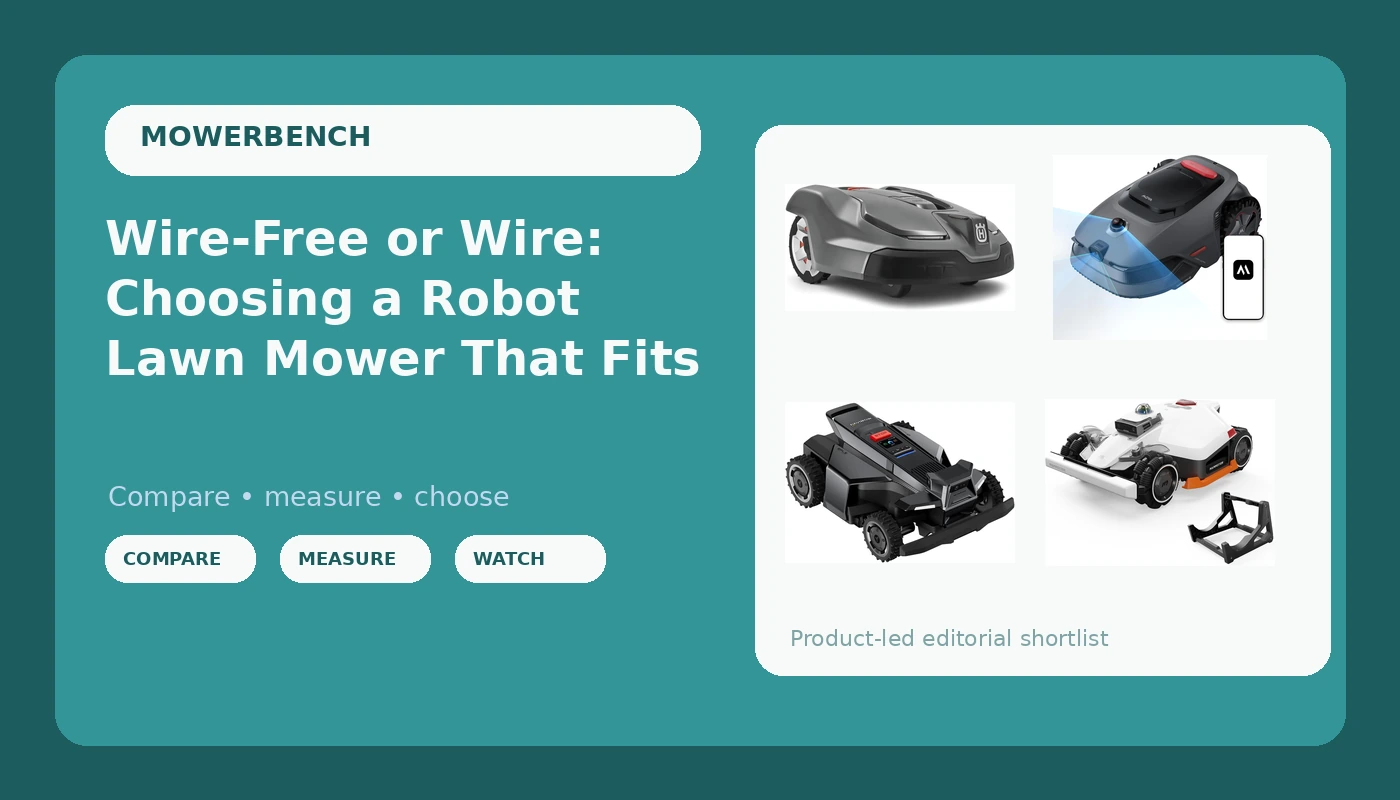
A robot lawn mower is a system, not an appliance, and the four machines in this explainer sit at four different points on that spectrum. Two cut without a perimeter wire at all, one leans on RTK plus LiDAR plus vision, and one is a renewed unit from a European brand whose design language is still built around a boundary wire. If you are shopping for a wire-free robot lawn mower, the hard part is not picking the listing with the biggest number on it. It is figuring out which of those numbers describes your lot: how much grass there is, how steep it gets, how much tree cover hangs over the lawn, and whether you are willing to give up a weekend to an install. This explainer walks through the four options, then through the decisions that separate a mower that runs every day from one that spends its life parked on the dock.
Related: Perimeter Wire vs RTK: What Survives a Real Winter →
Quick answer
Match the machine to the lawn, not to the spec sheet. For a quarter acre or less with no boundary wire, the MOVA LiDAX Ultra 1000 is sized for that job. For ground approaching an acre with serious slope, the Segway Navimow X430 is rated for it with 4WD. If you want all-wheel drive, LiDAR mapping, and a higher hourly coverage figure, the Mammotion LUBA 3 AWD 3000 lists all three. And if you would rather run a boundary wire and buy renewed European hardware with a documented area capacity, the Husqvarna AM430XH is the fourth path. Everything below is about which of those four descriptions sounds like your yard.
Four useful options
| Model | Best fit | What stands out |
|---|---|---|
| Mammotion LUBA 3 AWD 3000 | Steep, obstacle-heavy lawns that need AWD | 360° LiDAR with NetRTK and AI vision, AWD to 80% slopes, 5,400 sq ft/h |
| MOVA LiDAX Ultra 1000 | Suburban lots around 1/4 acre, no wire | RTK-free 3D LiDAR and AI vision mapping, zero-edge cutting, 45% slope |
| Segway Navimow X430 | Larger lots up to 1 acre with steep sections | 4WD rated to 84% slopes, zero-turn steering, two 180W motors |
| Husqvarna AM430XH (Renewed) | Buyers who want a wire-based install and a known brand | 3200 m² area capacity, renewed "Like New" listing |
The all-wheel-drive option: Mammotion LUBA 3 AWD 3000
Two things about this listing deserve attention before anything else. The cleaning stand ships separately from the mower, so a single delivery will not complete the setup, and you should plan where that stand lives before the boxes arrive. The cutting height tops out at 2.7 inches, which is a shorter range than several competitors; if you keep a tall fescue lawn in late spring, that ceiling matters more than the slope rating. The 5,400 square feet per hour figure is a coverage rate, not a lot size, and real-world throughput depends on how much of your lawn is obstacles, beds, and tight turns. All-wheel drive is the genuine differentiator here. Traction on wet grass is where two-wheel-drive machines lose their composure, and AWD is the mechanical answer to that problem.
The quarter-acre wire-free option: MOVA LiDAX Ultra 1000
RTK-free is the interesting phrase in that name. Standard RTK navigation depends on a fixed base station and a clear view of the sky, which is exactly what a mature maple canopy denies you. A machine that maps with LiDAR and vision instead does not care about satellite geometry, though it does need to see its surroundings, so a lawn that is one solid wall of shrubs will still test it. The 45% slope rating is the lowest of the four, and that is the honest trade for the simpler install. Up to 150 managed zones and dual maps is a lot of granularity for a quarter-acre lot, and it is genuinely useful if you want to exclude a dog run or run a separate schedule for a shaded strip. The 1.2 to 3.9 inch cutting range covers most cool-season lawns comfortably.
The large-lot option: Segway Navimow X430
An 84% slope rating is a traction claim made in a straight line on ground that the machine can grip. It is not a promise that the mower will happily traverse a wet side hill at that angle, because side-hill mowing is a different physics problem than climbing. Read it as headroom rather than a target. The zero-turn steering is the feature I would weigh most heavily on a large property, since a machine that pivots instead of arcing through every turn puts less scuffing on turf at the corners and finishes a boundary more cleanly. The 0.75 to 4 inch cutting range is the broadest of the four, which makes it the most flexible choice if you alternate between a short spring cut and a taller summer height.
The renewed wire-based option: Husqvarna AM430XH
Renewed is not a dirty word, but it does change your checklist. You are buying hardware that has been through someone else's hands, so confirm what the renewal covers before the return window closes, and budget an afternoon to lay and stake the boundary wire, because that wire is the install. The upside is that wire navigation is boring in the best sense. It does not lose a map after a firmware update, it does not care about tree cover, and the repair path on a widely sold platform is well trodden. The 3200 m² capacity works out to roughly 0.79 acre, which puts it in the same neighborhood as the acre-rated Segway without the satellite dependency.
Prices and availability may change. Product images, names, and retailer links are matched to verified listings. No current price, rating, stock status, or measured result is stated here without current evidence.
How wire-free mowers find their way
Wire-free navigation is not one technology. It is at least three, and the differences decide whether a machine works on your property.
RTK positioning uses a fixed reference station and satellite signals to place the mower within a few centimeters. It is precise and it is elegant, and it fails when the sky view fails. Dense canopy, a tall hedge line, or the north side of a building will degrade the correction signal, and the mower reacts by pausing, drifting, or refusing to start a schedule.
LiDAR mapping builds a map from laser returns instead. It does not need satellites, so tree cover is not the problem it is for RTK. It does need line of sight to surfaces, which means it can struggle in narrow corridors between a fence and a shed, and it can be confused by reflective surfaces or a lawn that changes shape dramatically mid-season.
Vision systems read the terrain and obstacles the way a camera does, which helps with things LiDAR sees poorly, like a garden hose or a dog toy. Vision is also the layer that most often improves with firmware, which cuts both ways: it can get better over time, and it can get worse after a bad update.
The Mammotion listing combines all three, and the MOVA listing deliberately drops RTK while keeping LiDAR and vision. That is the design decision worth understanding before you compare anything else.
What a slope rating actually measures
A slope percentage is rise divided by run. A 45% slope rises 45 units over 100 units of horizontal distance, which is roughly 24 degrees. The 80% and 84% figures on the Mammotion and Segway listings work out to about 39 and 40 degrees respectively.
Those numbers come from traction testing, and traction is not the same as stability. A mower can climb a straight ramp and still slide sideways on a wet cross-slope, which is why side-hill performance is a separate question from the headline rating. Wet grass, dew, loose clippings, and a dull blade all reduce grip, and so does cutting height: a machine riding low with more deck contact behaves differently from one set tall.
The practical read is to measure your steepest sustained slope rather than your steepest patch, add a margin for the days when the grass is wet, and treat any rating as a ceiling rather than a working target. If your property has a bank you already avoid mowing when it is damp, no rating on a box is going to change that.
- Walk the lot and note every zone you would want mowed separately.
- Measure the steepest sustained slope with a level and a tape, not by eye.
- Mark tree cover, fence lines, and narrow corridors that could block a signal or a sensor.
- Decide between a boundary-wire install and a wire-free design, then commit to one.
- Match cutting height to your grass species and the length you actually want, not to the default.
Getting the install right either way
- Replace blades on a schedule. Dull blades tear grass instead of cutting it, and the damage shows up as browning tips a few days later.
- Run the mower daily rather than weekly. Frequent light cuts beat one heavy pass, and the robot handles clippings better when they are small.
- Give the docking station a level pad, shade if you have it, and a route to power you will not have to move later.
- Leave a margin along beds, ponds, and gravel so the mower is not constantly negotiating a soft edge.
- Plan winter storage now. A charged battery, a dry dock, and a clean underside make spring startup far less interesting.
Which option should you choose?
Choose the Mammotion LUBA 3 AWD 3000 when your lawn is steep and cluttered and you want all-wheel drive plus LiDAR, RTK, and vision working together. Choose the MOVA LiDAX Ultra 1000 when your lot is around a quarter acre, you want no wire and no base station, and a 45% slope rating covers your ground. Choose the Segway Navimow X430 when you are mowing up to an acre, need 4WD and zero-turn steering, and want the widest cutting-height range in the group. Choose the Husqvarna AM430XH when you would rather run a boundary wire, want a documented area capacity, and are comfortable buying renewed hardware with a warranty check.
One caveat applies to all four. Every figure here comes from the manufacturer's listing rather than from a season in your yard, and the numbers that matter most, traction on wet grass, map retention after updates, and dock recovery in low light, are the ones no spec sheet reports. Buy from a listing with a return window you can actually use.
The bottom line
These four machines are not ranked versions of the same product. They are four different answers to the question of how a mower should know where it is: LiDAR plus RTK plus vision on all-wheel drive, LiDAR and vision with no RTK at all, 4WD acreage coverage with zero-turn steering, or a renewed boundary-wire platform with a capacity figure you can plan around. Pick the answer that matches your lot's size, slope, and tree cover, install it properly, and run it daily. The install is the product, and the mower is just the part that moves.