Related: Perimeter Wire vs RTK: Which One Survives a Minnesota Spring
I have installed more than 30 robot mowers for clients around Minneapolis, and I have never had a homeowner open the conversation with the right question. People ask about cutting height, app screenshots, and whether the thing can handle a little hill. Almost nobody asks how the machine knows where it is. That is the entire ballgame. Robot lawn mower navigation decides whether you end up with a lawn that quietly maintains itself or a machine you fish out of the hostas twice a week.
Right now there are three ways a mower locates itself: a perimeter wire buried around the lawn, GPS with RTK correction, and optical or visual navigation that reads the yard with cameras. The good machines blend two of the three. Every method has a failure mode, and every failure mode shows up in a specific kind of yard. Wire dies at a splice that corroded over winter. RTK drops under a maple canopy or alongside a neighbor's two story wall. Optical navigation struggles in deep shade and on a lawn whose shape changes every few weeks.
This guide is about matching the navigation to the property. The two mowers below cover the realistic paths for a suburban lot, and I have included two small items that keep an install running long after the robot arrives.
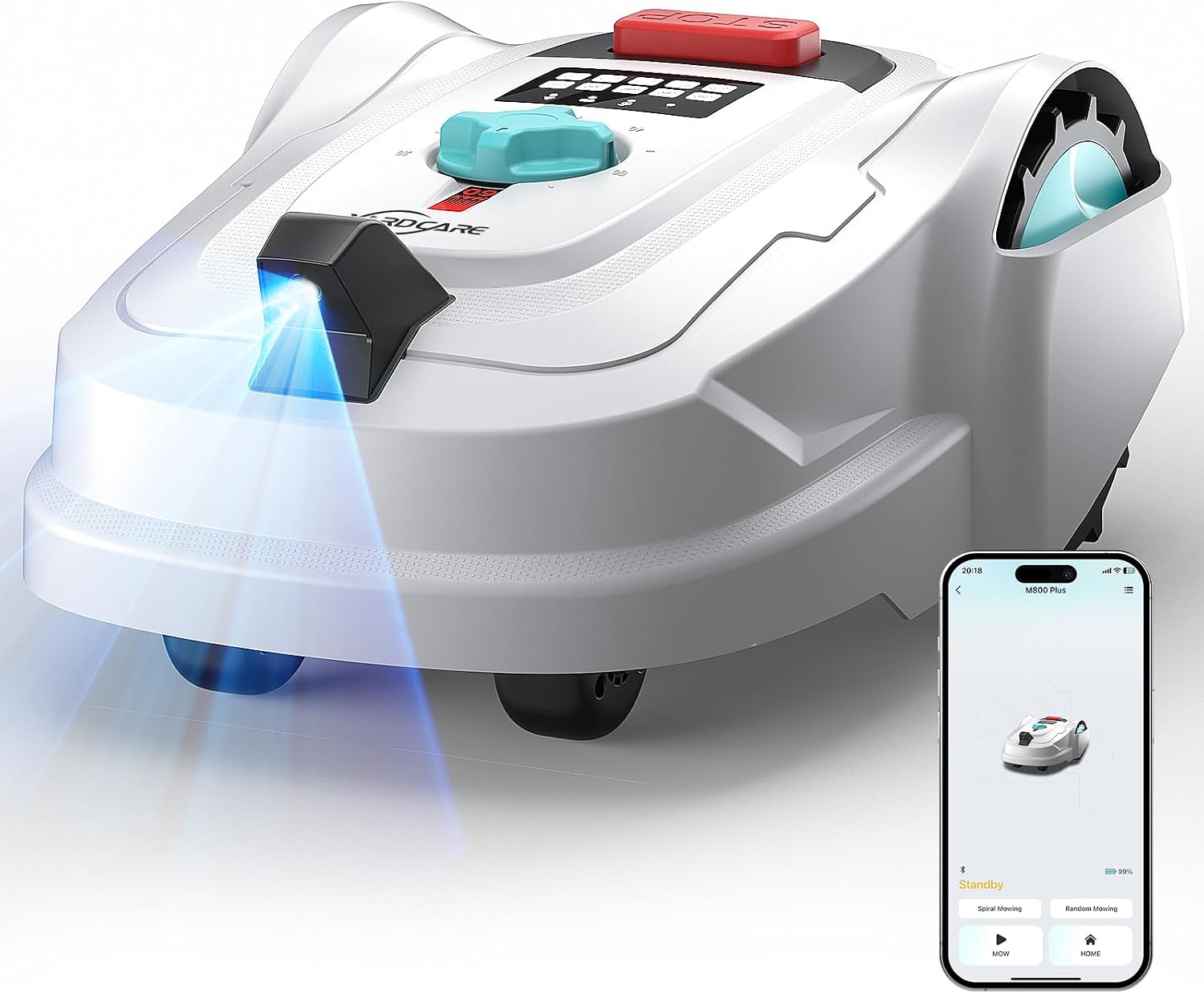
Best Overall for Most Yards: YARDCARE M800Plus
This is the machine I would put on a typical suburban lot without hesitation, because it solves the two problems that make people give up on robot mowers: the install and the trees.
Start with the install. There is no perimeter wire. The YARDCARE M800Plus navigates with GPS plus a visual system, which means you set the boundary in the app and the machine works from there. My clients do not mind buying a robot. They mind spending a Saturday afternoon on their knees with a edger and a spool of wire. Removing that step is worth real money to a lot of people.
Then there is the navigation itself. Two systems doing one job is the whole point. GPS with visual backup means that when the sky view gets crowded, under the maple in my own yard or between two houses, the camera picks up the slack. It is rated for up to 1/5 acre, which covers a normal suburban property with room to spare.
The bow-shaped path is the detail I appreciate most, and it is the one nobody advertises well. Instead of wandering the lawn at random angles and hoping it eventually covers everything, the mower works in deliberate bands. That means less overlap, fewer passes over the same strip, and a lawn that looks mowed rather than raked. Random walk mowers look fine after four hours. Banded mowers look fine after one.
Obstacle avoidance handles the stuff that shows up in a real yard: the dog's rope toy, the downspout splash block, the garden hose you forgot to coil. Height adjustment is in the app, which matters more than people expect. In a Minnesota spring you want to cut high while the ground is soft and wet, then drop it down as the grass thickens.
What I would tell a client: this is the mower for someone who wants the wire free install but does not want to bet the whole lawn on a single navigation system. Check current Amazon price before you commit, and measure your lawn first. If you are over a quarter acre, this is not the machine for you.
Best Value for a Small Lawn: LawnMaster OcuMow
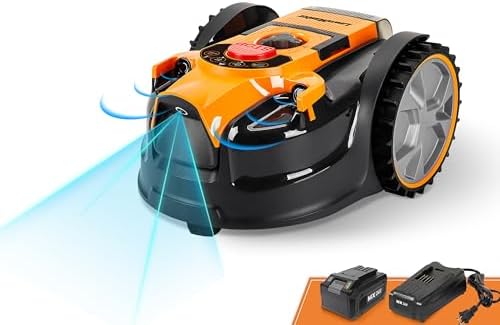
The OcuMow is aimed at a very specific buyer, and I want to be honest about who that is: someone with 1,000 to 2,000 square feet of lawn, mostly open, mostly sunny. That is a city lot, a townhouse yard, or the front lawn only of a bigger property. On that lawn, optical navigation is a good tool rather than a compromise.
Here is why. Optical navigation reads the yard with cameras. Cameras need light and they need a boundary they can see. A small, open, sunlit lawn with a clean edge along a driveway and a sidewalk is exactly the environment where that works. It is also the environment where the machine runs quiet enough that you forget it is out there, which matters if your yard is twenty feet from a neighbor's kitchen window.
No perimeter wire, same as the YARDCARE. That is the money saving part of this machine, and it is real. Wire kits, splices, and the weekend of labor add up, and a corroded splice is the single most common reason a robot mower stops finding its dock. Skip the wire and you skip that entire failure category.
The no go function handles the beds. I keep a perennial border and a vegetable patch, and any mower that ignores a no go zone will eventually prune the wrong thing. Set the zones in the app and the machine stays out.
The honest limits: this is a small lawn mower, so do not buy it for a half acre and hope. Optical navigation also wants sunlight, so if your lawn is shaded most of the day by a mature canopy, look at the GPS plus visual machine above instead. And like every wire free mower, it wants a clear view of the sky and the edges. Clean up the yard before the season starts and it will behave. Check current Amazon price.
The Replacement Decal That Keeps You Honest: Genie Slope Rating Decal
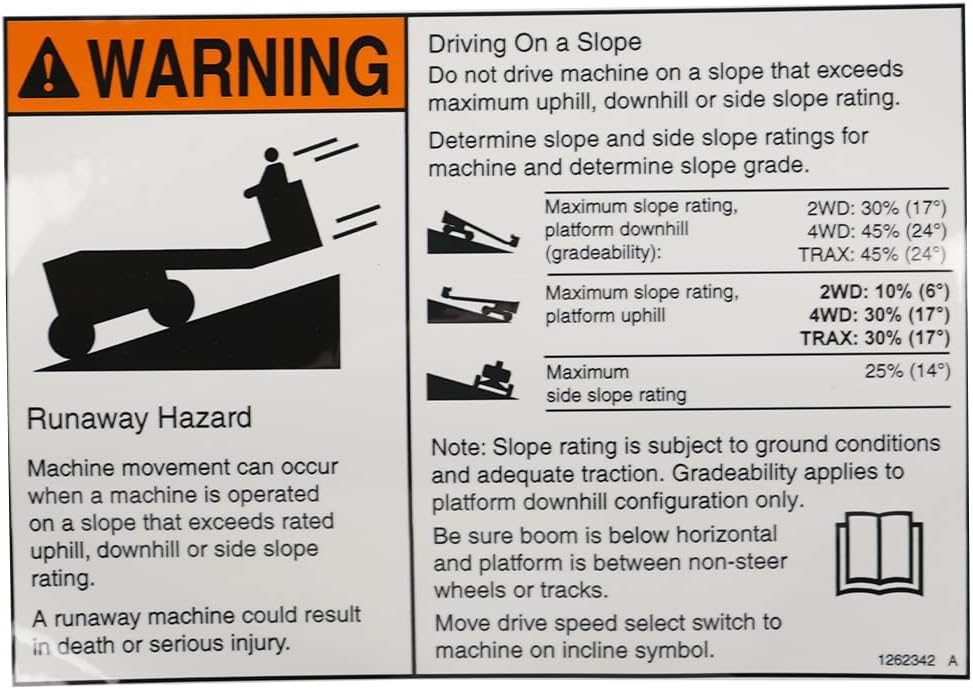
This one is a replacement slope rating decal for equipment that carries one, and it earns a spot in this guide because slope ratings are the most misread number in the entire category.
A slope rating on a label is a ceiling, not a target. It was measured on something dry, flat, and cooperative, and it says nothing about wet grass in April, which is when mowers actually slide. I have watched a machine rated for a steep grade lose traction and drift sideways on a slope well short of that number, and it was not the mower's fault. It was wet grass and a boundary that ran across the fall line instead of up it.
If the decal on your machine peeled off or faded, this is the replacement. If you are shopping, treat whatever number you see as the point where you stop asking the mower to work and start planning a different layout. Check current Amazon price.
The Book That Explains Where Your Hour Went: Power DiVa$ In Charge
Everybody who buys a robot mower talks about the hour they get back. Almost nobody plans for it. This is a time management book, and it is on this list for a practical reason: the first month with a robot mower is not hands off. You are adjusting boundaries, checking the dock, watching where it gets stuck, and learning your lawn's problem spots. That is a project, and projects go better when you schedule them instead of resenting them.
After the first month, the hour a week you were spending behind a mower becomes yours. Spend it on the beds, on the edging the robot cannot do, or on the porch. Check current Amazon price.
The comparison table
This is how the two mowers line up on the things that actually decide whether an install succeeds, plus the two support items above.
| Product | Navigation | Best lawn size | Key features | Price |
|---|---|---|---|---|
 Visit on Amazon → YARDCARE M800Plus |
GPS plus visual, no perimeter wire | Up to 1/5 acre | Bow-shaped path mowing, app control, 4.0Ah battery, obstacle avoidance, height adjustment | Check current Amazon price |
 Visit on Amazon → LawnMaster OcuMow |
Optical, no perimeter wire | 1,000 to 2,000 square feet | Obstacle avoidance, low noise, no go function | $399.99 |
 Visit on Amazon → Genie Slope Rating Decal S60 |
Not applicable | Not applicable | Replacement slope rating decal | $23.64 |
 Visit on Amazon → Power DiVa$ In Charge |
Not applicable | Not applicable | Time management book | $15.99 |
Read that table the way I do. The navigation column is the one that decides your experience. Everything else, cutting height, app layout, noise level, is adjustable or forgettable. A mower with the right navigation on the wrong lawn is a headache. A mower with the right navigation on the right lawn disappears into the background of your week.
How I judge navigation before I recommend a mower
I do not start with the mower. I start with a walk around the property, and I am looking at four things.
Sky view. How much of the lawn is open to the satellites? If a third of the yard sits under a mature canopy, GPS alone is a bad bet, and I say so before anyone spends money. This is the single most common reason a client comes back frustrated.
Slope and fall line. Not the number on the label, the actual shape of the ground and which way the water runs. A gentle slope crossed sideways is harder on traction than a steeper slope climbed straight up. If your boundary has to run across the fall line, plan for more wheel slip in spring and fall.
Boundary complexity. A simple rectangle with a driveway edge is easy for any navigation system. A yard with a swing set, a fire pit, three beds, and a narrow side gate is not. Wire free machines handle complexity through the app, and the more complex the yard, the more time you spend in that app during the first month.
Dock access. Can the machine find its way home from the far corner, in the dark, in October? Every robot I have ever seen fail a homeowner did it at the dock, not in the middle of the lawn. Give the dock a clear approach and a little shelter, and you will not be carrying the mower back by hand at 8 p.m.
Two more things I tell every client. First, mowing frequency beats mower quality. A modest robot running daily keeps a lawn looking better than a premium machine running once a week, because grass never gets tall enough to need a second pass. Second, blade condition is the hidden cost of ownership. Dull blades tear grass instead of cutting it, and torn tips go brown. Check your blades monthly during the growing season and replace them when the cut starts looking ragged. Nobody puts that in the brochure.
On the wire versus wireless question, I install wire for clients who want boring reliability and cannot guarantee a clear sky view. For an open suburban lot with a decent view of the satellites, a wire free machine with a backup navigation system is where I would put my own money now. The technology has caught up to the marketing.
Should you buy the YARDCARE M800Plus?
Yes, for most suburban lots up to about 1/5 acre. It takes the two worst parts of robot mower ownership, the buried wire and the single point of navigation failure, and it addresses both. GPS plus visual navigation means the camera keeps working when the satellites get crowded, and bow-shaped path mowing means the lawn gets covered in bands rather than by luck. Obstacle avoidance and app-based height adjustment round out what a real yard actually needs.
The caveat is size. If your property runs past a quarter acre, buy a machine built for the acreage instead of asking this one to stretch. And if your entire lawn sits in deep shade, no camera-based system will love you.
Should you buy the LawnMaster OcuMow?
Yes, if your lawn is small, open, and sunny. In the 1,000 to 2,000 square foot range, optical navigation is a sensible design rather than a shortcut, and skipping the perimeter wire saves you both money and a weekend. The no go function protects beds, the machine runs quiet, and obstacle avoidance handles the dog toys and the hose.
Buy it for the lawn you have, not the lawn you might have someday. Small, sunlit, and simple is the target. If that describes your yard, this is the value pick in this guide. Check current Amazon price and measure twice.