
A robot lawn mower setup is an install problem before it is a robot problem. I have watched homeowners unbox a mower, drop the dock in the shadiest corner of the yard, and then spend three weeks blaming the machine for a boundary they never marked. The robot did exactly what it was told.
I spent 15 years installing lawns before I moved into reviewing robot mowers, and I have set up more than 30 of them for clients around the Twin Cities. The yards that work are the yards where somebody walked the perimeter with string and stakes before anything got cut. That is the whole secret, and it is not much of a secret.
This guide is the order of operations for a small suburban lot, roughly a quarter acre or less. It covers the two mowers I would put on that kind of property: an app-controlled unit sized for lawns up to 1/8 acre, and an all-wheel-drive machine with LiDAR and RTK for a yard with a real slope. Do the install right and the mower becomes boring, which is the highest compliment I can give a piece of outdoor equipment.
Why you should trust me
I live on a 0.4-acre lot in Minneapolis with a garden, a dog that chases anything that moves, and a side yard that holds water every March. I have run six different robot mowers through two full Minnesota seasons, including winter storage, spring installs, and the mulberry leaf clog of 2024 that taught me more about dock placement than any manual.
Before that I installed lawns for 15 years. Robot mowers are the only product I have ever sold to clients where the install matters more than the machine, and I keep the string-and-stake maps to prove it. Every install gets a paper map with the boundary, the dock, the no-go zones, and the date, because when something goes wrong in July you will not remember what you did in April.
How I judge a mower before it goes in the ground
Four things decide whether a mower fits your yard, and none of them are the marketing copy.
Navigation. Wire is boring and it works. RTK is elegant and it fails under a maple tree. If your yard has heavy canopy, a wire boundary or a hybrid system will save you a summer of frustration. If your yard is open sky, RTK and LiDAR machines are genuinely easier, because there is no wire to bury.
Cutting height range. Look at the low end and the high end. A mower that will not go above 2.5 inches will scalp a fescue lawn in July. A mower that will not go below 1.5 inches leaves a warm-season lawn shaggy. Match the range to your grass, not to the biggest number on the box.
Slope behavior. Slope ratings are marketing. I have watched a mower rated for 25% slide sideways on wet grass at 18%. What matters is whether the machine has all-wheel drive, how it turns on an incline, and whether it refuses a slope rather than sliding down it.
The dock. A docking station needs level ground, power, and drainage. If the dock sits in a low spot, the mower parks in a puddle. If it sits in deep shade, the mower may not find it after dark. Dock placement is the single most common reason a client calls me back.
What you need before install day
Do not open the box until you have these.
- A boundary plan. Walk the yard and decide what is lawn and what is not. Beds, tree rings, the dog's digging corner, and the strip along the fence all need a decision. Draw it.
- String and stakes. Mark the boundary on the ground. This takes an hour and saves a week.
- A level dock pad. A paver base or a small gravel pad is fine. Slope and drainage are what break a dock.
- An outdoor outlet within reach. The dock needs constant power. If the outlet is on the far side of the house, deal with that before you lay anything out.
- A cutting height decision. Set it for the season, not for the first cut. For most northern lawns that means 3 to 3.5 inches in summer.
- A plan for the dog. Freshly laid boundary wire is a chew toy. So is a mower that bumps into a sleeping Lab at 6 a.m.
The two mowers this guide covers
Both of these are built for a small suburban lot, and they solve the problem from opposite ends. One is a lightweight, app-driven machine for a yard that fits inside 1/8 acre. The other is a heavy all-wheel-drive unit for a property with a genuine slope and more ground to cover.
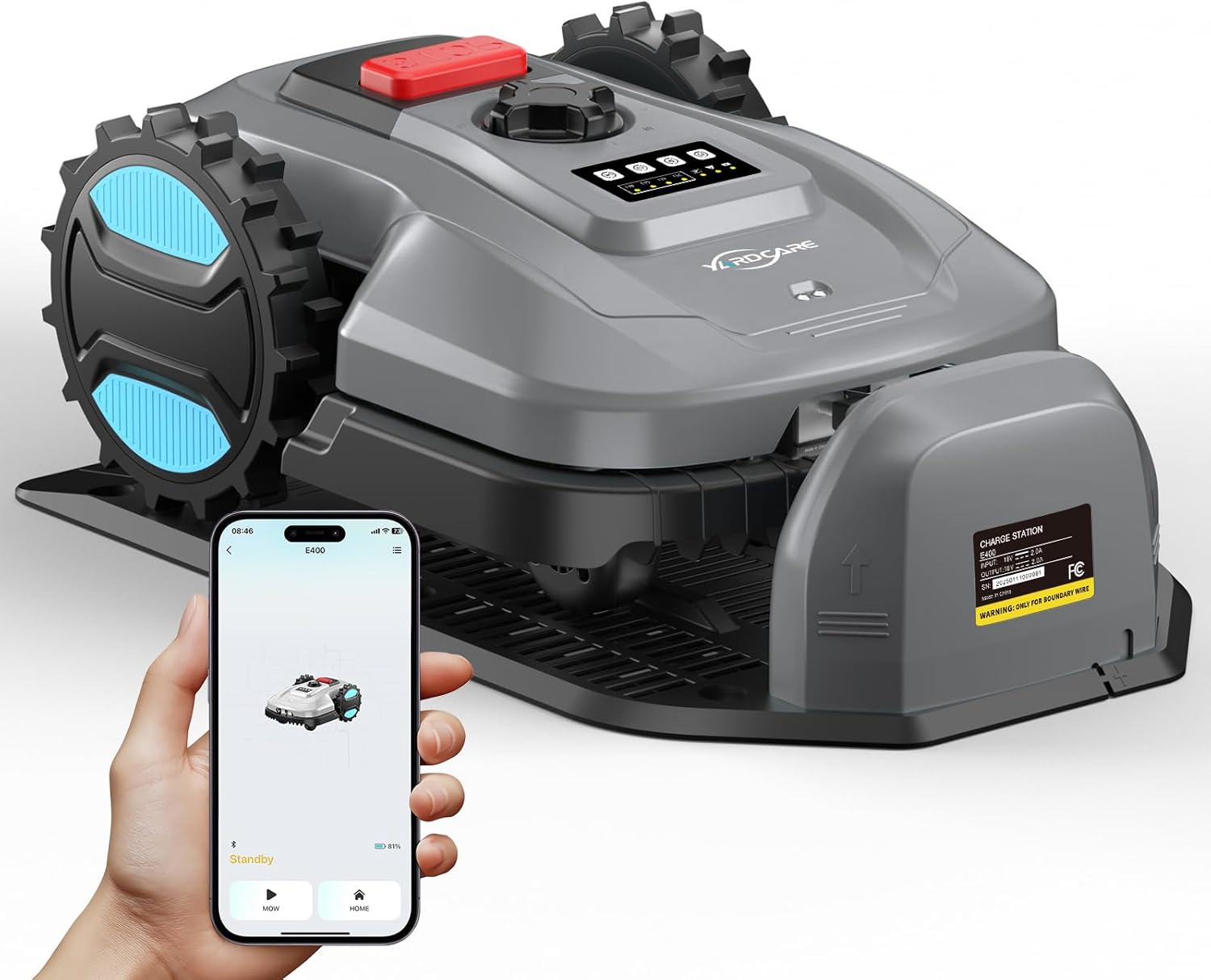
Budget pick: Robot Lawn Mower with App Control, Adjustable Cutting Height, Auto-Charging, Obstacle Detection & Smart Scheduling, Ideal for Lawns up to 1/8 Acre
 Visit on Amazon →
This is the class of mower I recommend to the neighbor with a standard city lot: front yard, back yard, a strip along the alley, and nothing complicated. The feature list covers the four things that matter at this size. Adjustable cutting height lets you set the deck for your grass instead of accepting whatever the factory chose. Auto-charging means the mower returns to the dock on its own and comes back out when it has enough charge, which is what makes a robot mower a system rather than a toy. Obstacle detection keeps it from grinding into the grill or a forgotten hose. And smart scheduling through the app is what turns a weekly cut into a daily one, which is where lawn quality actually comes from.
The 1/8 acre ceiling is real. If your property is bigger than that, you will spend the season watching the mower run out of charge in the far corner, and you should read the upgrade pick below.
Flaws but not dealbreakers: At this size, expect to install a boundary wire yourself, and expect obstacle handling to be a bump-and-turn affair rather than full avoidance. Neither is a dealbreaker. Both are things to know going in.
Anyone with a quarter-acre-or-less lot and a flat to gently sloped yard will get the most out of this mower.
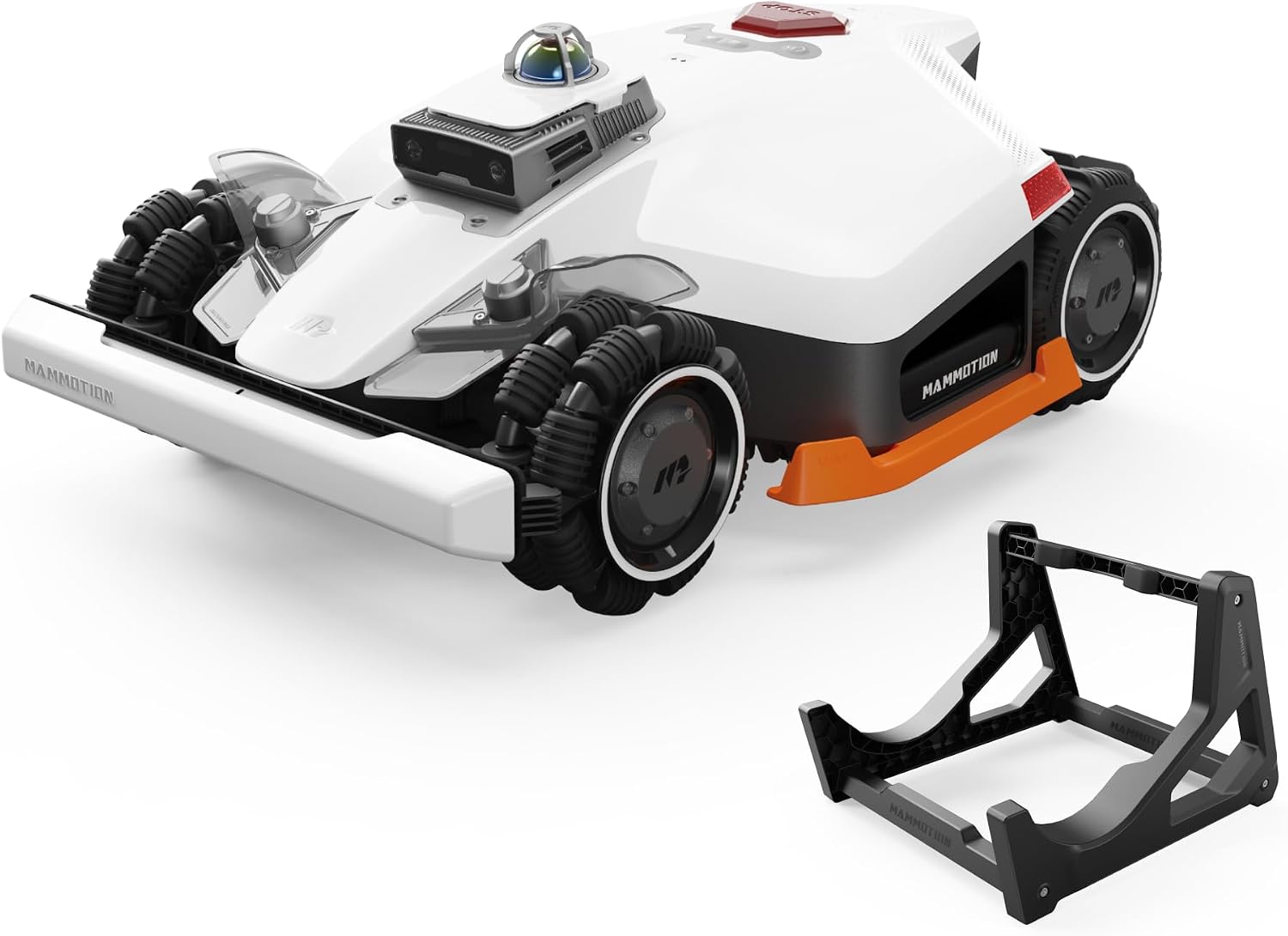
Upgrade pick: Mammotion LUBA 3 AWD 3000 Robot Lawn Mower with Cleaning Stand (Ship Separately), 360° LiDAR+NetRTK+AI Vision, AWD for 80% Slopes, 5400 sq.ft/h, Cutting Height 1.0"-2.7"
 Visit on Amazon →
This is the machine for a yard that has a real problem in it: a slope, a big open lawn, or both. The 360-degree LiDAR, NetRTK, and AI vision mean it maps and navigates without depending on a wire the way the budget pick does, which is a genuine advantage on an open lot and a genuine liability under heavy tree canopy. All-wheel drive is the feature I care about most, because a driven wheel at every corner is what keeps a mower from sliding sideways on a wet incline. The cutting height range runs from 1.0 inch to 2.7 inches, which covers a low warm-season cut at one end and a moderate cool-season cut at the other. The 5,400 square feet per hour figure is the manufacturer's number, so use it for planning and then discount it for corners, turns, and charging.
Flaws but not dealbreakers: The cleaning stand ships separately, so plan on two deliveries and check both tracking numbers before you assume something is missing. A mower rated for 80% slopes is a mower that will attempt 80% slopes, and attempting is not the same as holding. On wet grass, schedule it away from the morning dew. And under a dense maple canopy, expect RTK to be the weak link, not the LiDAR.
Anyone with a sloped or larger property who wants to skip the wire entirely should start here.
The install, step by step
Step one: Decide the boundary on paper first. Walk the yard with the map. Mark every bed, tree, post, and downspout. If you are installing wire, this is where you plan the loop and the run back to the dock. If you are installing an RTK or LiDAR mower, this is where you decide which zones become no-go areas in the app.
Step two: Build the dock pad. Level it, compact it, and make sure water runs away from it rather than under it. Set the dock so the mower approaches the way the manual shows, usually straight on with a couple of feet of clear runway.
Step three: Run power to the dock. Outdoor outlet, GFCI protection, and enough slack that you are not straining the connector. If you are running a cord across a walkway, fix that now, because you will trip over it in the dark in September.
Step four: Lay the boundary or map the yard. For wire, stake it loosely and test before you bury it. For RTK, put the reference station where it has the clearest view of the sky, then walk the boundary with the mower or the app, whichever the manual calls for. A boundary that is 10 inches off in April is a flowerbed destroyed in June.
Step five: Deal with the obstacles. Dog toys, hammock straps, garden hoses, the low branch on the crabapple. Obstacle detection is a backup, not a strategy.
Step six: Set the cutting height and the schedule. Start higher than you think you need, then step down over two weeks. Schedule daily, or at least every other day. Mowing frequency beats mower quality every time, and a mower running daily never takes off more than a third of an inch at once.
Step seven: Watch the first three runs. Stand outside with a coffee and follow it. You will learn more in three runs than in three weeks of reading app logs. Fix the boundary, the no-go zones, and the schedule while you still remember what you did.
Where installs go wrong
Splices. Any wire splice sitting in wet soil will corrode. Use the manufacturer's connectors, keep splices above grade where you can, and mark them on your map so you can find them in two years.
The dock in the dark. A mower that cannot find its dock after dusk will run until the battery dies. If your dock is in shade or behind the garage, test a night return before you trust it.
Cutting too low too soon. Scalping a lawn in April is how you get weeds in June. Start high.
Losing the map. Firmware updates occasionally reset a map, and RTK mowers can lose position under canopy. Keep your boundary on paper, because the app will not always remember for you.
Dull blades. A dull blade tears grass instead of cutting it, and the tips go yellow. Check blades monthly through the growing season.
What this costs you in time
The hardware is the easy part, and you can see what either mower runs by checking the current price on the listings above. The install is where the hours go. Plan a full afternoon for the first setup, most of it spent on the boundary and the dock pad rather than the mower itself. Add one short session the following weekend to fix the corners you got wrong.
After that the ongoing cost is small but not zero. Ten minutes a week to check the boundary and clear debris. Ten minutes a month for blades. An hour in the fall to clean and store the mower and dock for a Minnesota winter. That is roughly the time it takes to mow the lawn twice, and it buys you a season of not mowing it at all.
The honest answer
A robot mower will not fix a yard with a bad boundary, a bad dock, or a bad schedule. It will expose all three. Do the install first, give it the afternoon it deserves, and then let the machine handle the boring part. That is the whole job, and it is worth doing once.