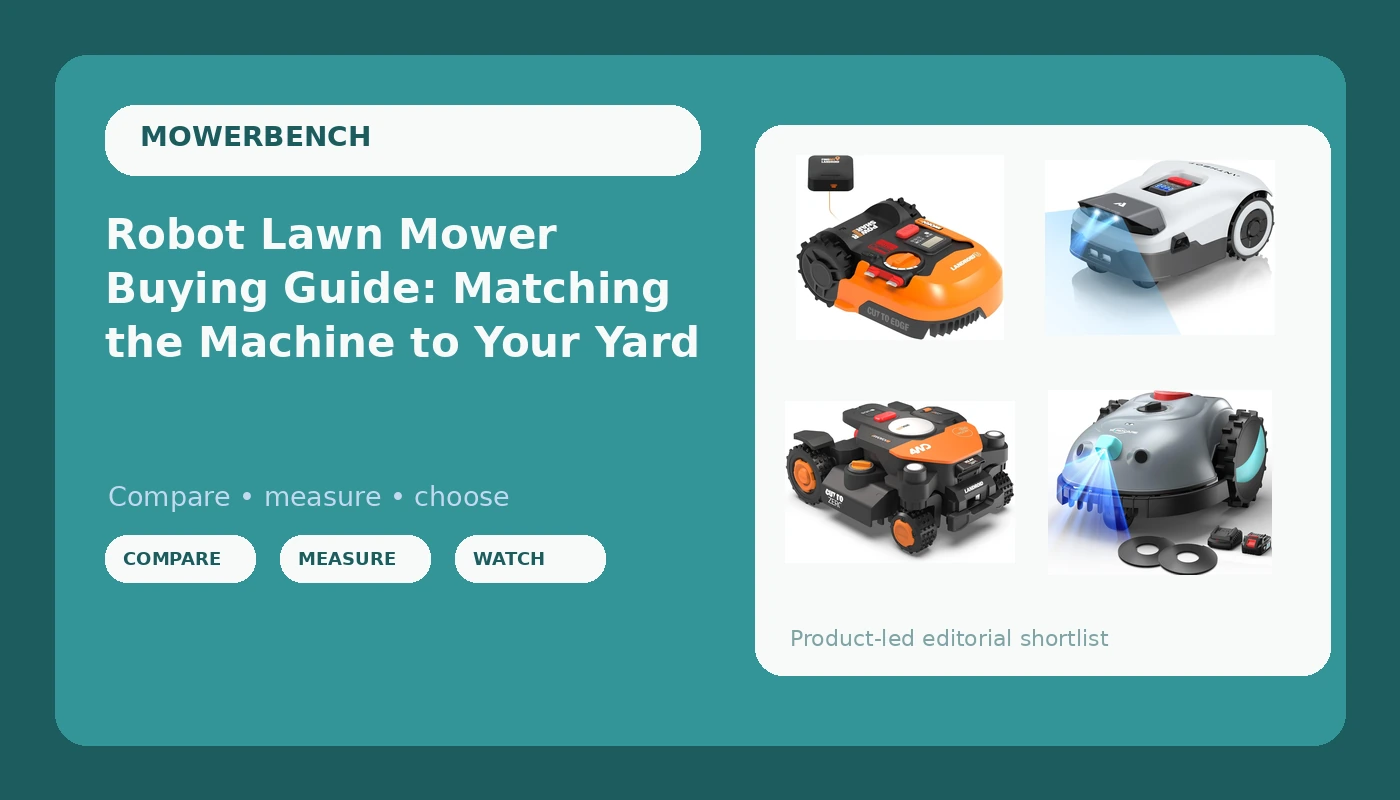
If you have spent an evening comparing robot lawn mowers, you have probably noticed that the listings disagree about almost everything except the promise. Some models arrive with a boundary wire, some advertise no perimeter wire at all, and a few use GPS or vision language without explaining what happens when a maple tree sits between the mower and the sky. This robot lawn mower buying guide is built around the question that actually decides whether you will love the thing: what kind of navigation does your yard support, and how much setup work will you tolerate in exchange for it. Coverage ratings matter too, but they matter second. Below are four current models that span the range from a compact 1,600 square foot lawn up to half an acre, with notes on where each one fits and what you give up to get it.
Related: Perimeter Wire vs RTK: What Survives a Minnesota Spring →
Quick answer
The right robot mower is the one whose navigation method matches your yard and whose coverage rating matches your actual turf. Wire-free models such as the ANTHBOT Genie 600 and the WORX WR342 remove the burial work entirely, but they depend on their onboard positioning holding up across every corner of the lawn. A GPS-assisted model like the WORX Landroid M adds satellite positioning to its navigation package, and the YARDCARE V100 leans on HD vision for small, uncomplicated lawns. Match coverage first, navigation second, and the install you are willing to do third.
Four useful options
| Model | Best fit | What stands out |
|---|---|---|
| WORX Landroid M 20V Robotic Lawn Mower w/GPS 1/4 Acre / 10,890 Sq.Ft Power Share- WR143 (Battery & Charger Included) | Lawns up to 1/4 acre | Listed coverage of 1/4 acre (10,890 sq ft), GPS assistance, and a 20V Power Share battery and charger in the box |
| ANTHBOT Genie 600 Robotic Lawn Mower NO Wire | Mid-size yards where you would rather not bury cable | Sold as a no-wire design |
| WORX Robot Lawn Mower 4WD for 1/2 Acre, No Perimeter Wire, WR342 | Larger or uneven lawns up to 1/2 acre | Four-wheel drive plus a 1/2 acre coverage rating and no perimeter wire |
| YARDCARE V100 Automatic Robot Lawn Mower HD Vision for Lawn Max 1600 sq ft | Small, simple lawns | HD vision navigation with a listed maximum of 1,600 square feet |
The wired workhorse with GPS: WORX Landroid M 20V Robotic Lawn Mower w/GPS 1/4 Acre / 10,890 Sq.Ft Power Share- WR143 (Battery & Charger Included)
Here is the trade-off you are accepting. The listing does not carry the no-perimeter-wire claim that two of the other models here do, which in practice means a boundary has to be established and the mower follows it. That boundary is the part homeowners underestimate. Unboxing the robot takes minutes; laying out and staking a perimeter takes an afternoon, and it is the single most common reason people give up on a robot mower before the first cut. The payoff is that a properly installed boundary does not care about tree cover, cloud, or a metal shed in the side yard. It keeps working in conditions that make satellite and camera navigation hesitate, which is why wire installs remain the default recommendation for yards with mature trees.
The wire-free mid-size pick: ANTHBOT Genie 600 Robotic Lawn Mower NO Wire
Wire-free is genuinely appealing, and it is also where the marketing gets ahead of the physics. Removing the perimeter wire removes the install labor, but it moves the burden onto onboard positioning, which has to stay accurate across the whole lawn, not just the easy middle. Dense canopy, a narrow side yard between a house and a garage, a metal shed, or a fence line that confuses the return path are the situations that expose the difference. The other thing to plan for is the docking station: every wire-free mower still needs a home base with power, and it still has to find that base reliably, including on the days it runs late and finishes after dark. Confirm the coverage rating for your specific lawn before ordering, because it is not printed in the model name here.
The big-yard four-wheel-drive option: WORX Robot Lawn Mower 4WD for 1/2 Acre, No Perimeter Wire, WR342
Four-wheel drive is not a gimmick on a robot mower. Traction is what keeps a machine from sliding sideways on a damp slope, and it is the difference between a mower that handles a slightly uneven yard and one that gets stuck and sends you a notification while you are at work. The caveat is coverage math. A half-acre rating describes an open, mostly rectangular lawn with a clean path to the dock. If your half acre is really three strips separated by planting beds, a driveway, and a shed, the mower spends a meaningful share of its runtime commuting rather than cutting. Treat any coverage number as a ceiling, not a target, and size one step up if your lawn is chopped up or if you want the robot to run less than daily.
The small-lawn starter: YARDCARE V100 Automatic Robot Lawn Mower HD Vision for Lawn Max 1600 sq ft
Small lawns are where robot mowing works best, and it is worth saying plainly. A machine that runs every day on 1,600 square feet never lets the grass get ahead of it, and short clippings disappear into the turf as mulch instead of collecting in a bag. Vision-based navigation fits that scenario because a small lawn usually has clear boundaries: a driveway, a walkway, a fence, a hedge. It is less forgiving on a lawn where the edge is a flower bed that changes shape every spring, or where a large tree casts a hard shadow line across the whole area for most of the day. If your lawn is genuinely small, this is the category where the price-to-benefit ratio makes the most sense.
Prices and availability may change. Product images, names, and retailer links are matched to verified listings. No current price, rating, stock status, or measured result is stated here without current evidence.
Wire, GPS, and vision: how the three navigation systems differ
Every robot mower on this list uses one of three ways to know where it is, and the differences explain most of the complaints you will read about.
Perimeter wire is the oldest and most predictable. A boundary cable is laid around the lawn, usually staked just under the turf, and the mower reads the signal to know where the edge is. It is boring, and boring is a feature. Wire works under full tree canopy, in overcast weather, and at night. Its weaknesses are install labor and physical damage: a cable nicked by an edger, a spade, or a rodent creates a break that stops the mower until you find it. Corrosion at splices is a known weak point in wet climates, so any splice should be treated as a temporary measure rather than a permanent one.
GPS and RTK positioning replace the wire with satellite correction. The mower carries a receiver, and a reference station improves accuracy enough to hold a virtual boundary. There is no cable to bury, which is a real advantage on a lawn crisscrossed by irrigation lines or paving. The failure mode is signal: dense canopy, a tall house wall on the north side, or a metal outbuilding can degrade the fix, and a mower that loses position may wander, pause, or miss sections.
Vision navigation uses cameras and onboard processing to read the lawn instead of a boundary or a satellite fix. It needs reasonable light and visible edges to work with, which makes it a good fit for small, clearly defined lawns and a poorer fit for cluttered, heavily shaded ones.
Sizing the robot to your lawn, step by step
- Measure turf area, not lot size. Subtract the house footprint, driveway, patio, beds, and any area you do not mow. A quarter-acre lot is rarely a quarter acre of grass.
- Walk the boundary and list the obstacles: trees, beds, a swing set, a dog that treats the mower as a rival, and any passage narrower than the mower itself.
- Decide how much install work you will accept. Wire is an afternoon with a spade or a lot of stakes. Wire-free is closer to an hour, with the caveat that positioning has to hold up everywhere.
- Pick a docking station location with power and a clear approach. Every mower on this list returns to a dock, and a blocked approach turns a working robot into a lawn ornament.
- Match the mower to how often you want it running. Daily cutting at a low height is easier on the machine and the grass than weekly cutting at a tall one.
What to check before you order
- Confirm the listed coverage comfortably exceeds your measured turf area, especially if the lawn is broken into separate zones.
- Check whether the model requires a perimeter wire, because that single detail decides your first weekend with the machine.
- Verify what is in the box. Battery and charger inclusion varies by model and changes the real cost considerably.
- Look at the cutting height range against how you actually like your lawn. Very short cuts demand more frequent mowing.
- Plan for blade replacement as an ongoing cost rather than a one-time purchase, and check how the blades are removed.
- Think about winter. Any robot mower needs to come inside, be cleaned, and have its battery stored properly during a Minnesota offseason.
Which option should you choose?
Choose the WORX Landroid M 20V Robotic Lawn Mower w/GPS 1/4 Acre / 10,890 Sq.Ft Power Share- WR143 (Battery & Charger Included) when your lawn is up to a quarter acre, you have tree cover that satellite navigation alone would struggle with, and you want a battery system that shares a platform with other tools in the same line. Choose the ANTHBOT Genie 600 Robotic Lawn Mower NO Wire when you want the install done in an afternoon and your lawn is open enough for onboard positioning to stay locked on. Choose the WORX Robot Lawn Mower 4WD for 1/2 Acre, No Perimeter Wire, WR342 when you have more ground to cover, uneven terrain, and you would rather not bury cable across it. Choose the YARDCARE V100 Automatic Robot Lawn Mower HD Vision for Lawn Max 1600 sq ft when your lawn is small and simple, and daily cutting is the goal rather than occasional rescue mowing.
One caveat applies to all four. Coverage ratings, slope handling, and navigation reliability are all tested under favorable conditions, and the published numbers describe the best case. The honest way to choose is to measure your own lawn, count your own obstacles, and be skeptical of any rating that sounds like it was measured on an open field.
The bottom line
The install is the product, and the mower is the robot that executes it. A wire-free design removes the burial work but asks more of onboard positioning; a wire-based design asks for an afternoon of setup and then delivers predictable behavior for years, including under the trees that break satellite fixes. Coverage ratings should be treated as ceilings, so size up if your lawn is fragmented or shaded. Start with the area you actually mow, decide how much install work you are willing to do, and then pick the model whose navigation matches that answer. Any of these four can keep a lawn cut all season if it is matched to the right yard.