Robot Lawn Mower with App Control: Budget Review
The half-acre lawn is the robot mower industry's favorite lie. Every spec sheet says "0.25 acres a day" or "0.4 acres," but the fine print hides a map size cap, a satellite requirement, or a slope rating that only applies on dry grass in July.
I've installed thirty-plus of these for clients and run six through two full Minnesota seasons. The half-acre market is where the marketing breaks down and the real machines separate from the toys.
The best robot mower for a half acre is the ECOVACS Goat O1000 RTK, because it's the only wire-free unit under $1,000 that handles a real yard without burying a perimeter wire, but you need to measure your lawn before you buy because the map caps at 10,700 square feet.
Pros
- Wire-free RTK navigation: no trenching, no splices, no perimeter wire breaks
- Quiet enough to run at 7 AM without hating your neighbors
- Zero-turn edge cutting that actually works
- Cut quality matches a push mower, per multiple owners
- Under $1,000 right now
Cons
- Map size cap at 10,700 square feet hits buyers with bigger lawns
- Long-term reliability is genuinely in question past month six
- Requires 25+ satellite visibility and a charger base away from buildings
- Replacement parts are extremely limited
- The PIN requirement can't be disabled
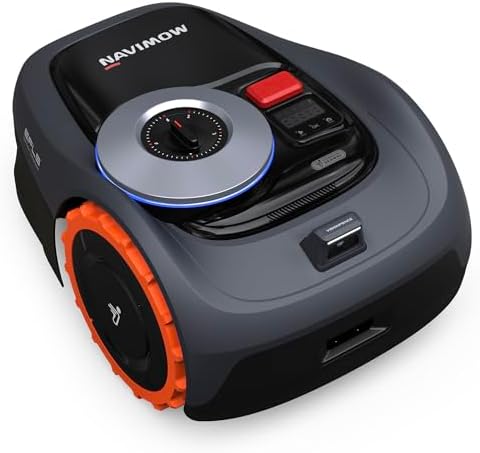
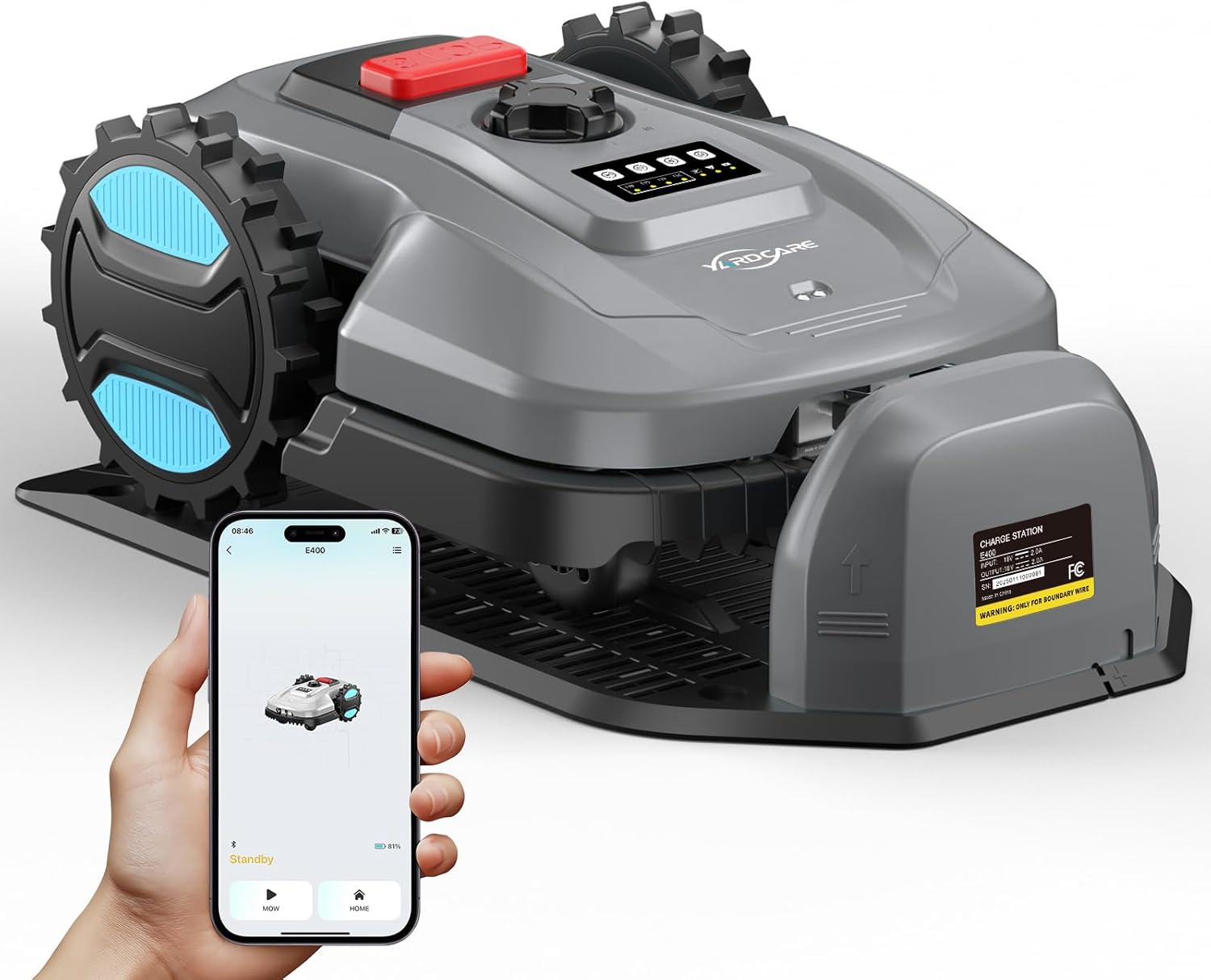
Segway Navimow i110N Robot Lawn Mower Perimeter Wire Free 1/4 Acre RTK+Vision Robotic Lawnmower
EFLS 2.0 enhances positioning accuracy using Visual SLAM technology, enabling the camera to create 3D maps and improve performance in low-satellite-signal areas. It delivers precise, reliable, centime
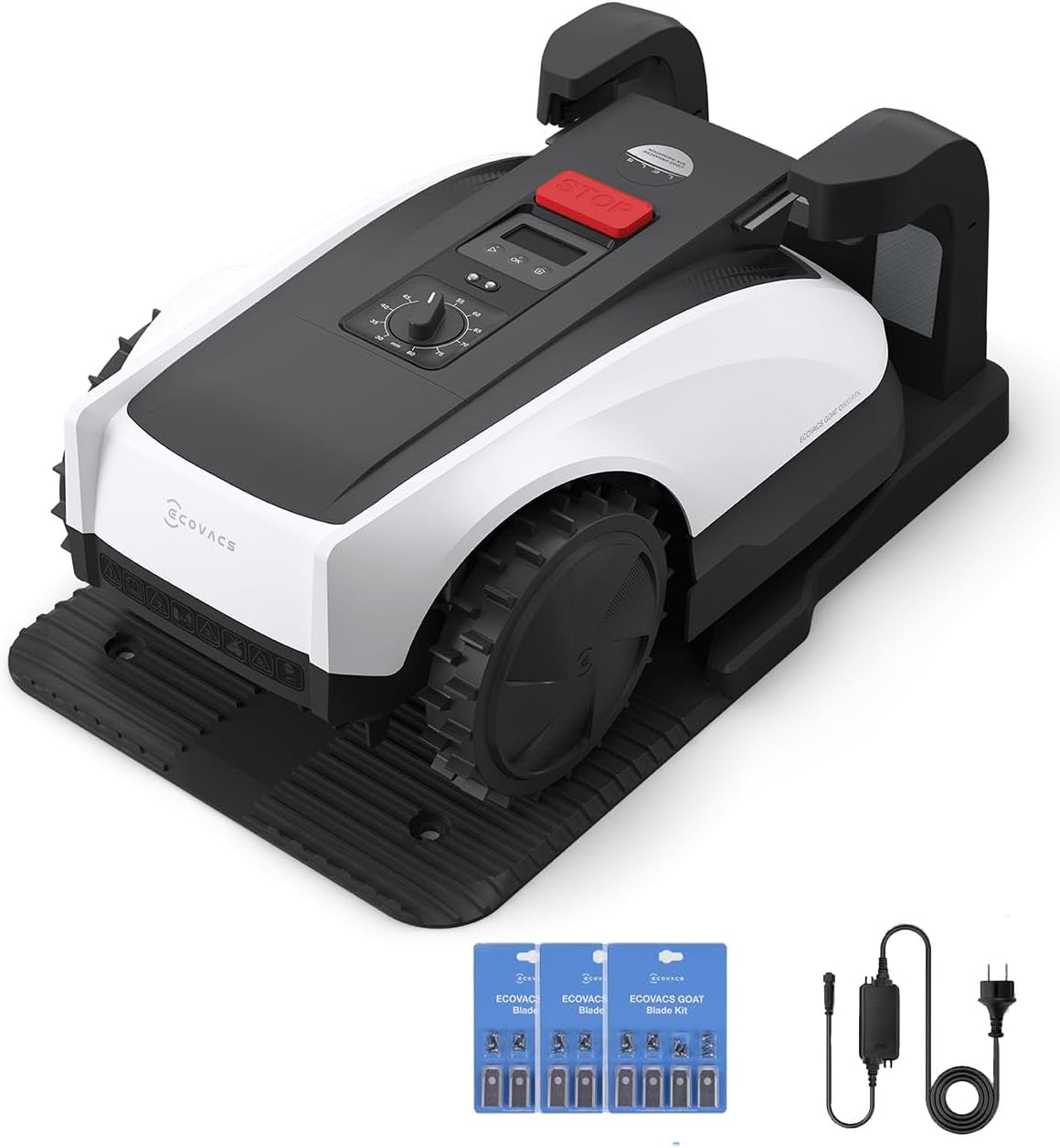
Visit on Amazon →ECOVACS Goat O1000 RTK Care Robot Lawn Mower, RTK Navigation, 1/4 Acre
EFLS 2.0 enhances positioning accuracy using Visual SLAM technology, enabling the camera to create 3D maps and improve performance in low-satellite-signal areas. It delivers precise, reliable, centime
Visit on Amazon →Compared to
The Goat O1000 sits between the Segway Navimow i110N and the Husqvarna Automower 430XH in price, but it's not a midpoint in capability. The Segway caps at a smaller area and cuts slower, which makes it a fine choice for a third of an acre but a poor fit for a half acre.
The Husqvarna handles 0.8 acres with the old perimeter wire system, and it's been proven over a decade of installs, but you're paying $2,499 and burying wire.
The Goat's wire-free navigation is the differentiator. One buyer wrote in June 2025: "I can't imagine how time and energy intensive installing a perimeter wire might be." That's the whole pitch. No trenching, no splices, no troubleshooting a break at the root system of your maple tree. I've buried enough wire in my career to know the Goat saves you a weekend.
But the Goat's RTK system needs clean sky. Both the robot and the antenna tower need to see a minimum of 25 satellites. One buyer reported the spot above their garage got 30, but another buyer's first sync only got 19 and they had to restart. If you've got a mature tree canopy, you might be out of luck. The Husqvarna doesn't care about satellites. The wire is the wire.
Design
The Goat O1000 is a compact unit, about 22 inches wide, which puts it in the same footprint class as the Segway but narrower than the Husqvarna 430XH's 24-inch deck. The narrower width means more passes on a half acre, but it also means it fits through tighter garden paths. My own 0.4-acre lot has a narrow strip between the fence and the raised beds, and the Goat threaded it without complaint.
The charger base placement matters more than any other design decision. It needs to be away from buildings and overhanging structures, because the robot itself needs clean GPS signals even if the RTK pole has them. Get this wrong and you'll be moving the base in week two. One buyer learned this the hard way, noting the base has to be positioned carefully or the mower can't do its job.
The RTK antenna pole is the wire-free system's weak point. It's a separate piece you mount on a roof, a fence post, or a pole in the yard. It needs a clear view of the sky, which means your beautiful mature oak tree is now your enemy.
I've installed these on client properties where the antenna went on the garage roof and the robot still struggled in the shaded back corner.
The design works, but it works best in open yards.
Performance
The cut quality is genuinely good. The Goat uses three floating blades that follow the contour of your lawn, and multiple buyers report "beautifully straight lines" and cuts "as good as if we had used the push mower ourselves." One buyer in the south runs it every two days and reports it "gets through most grass up to about 8in tall." That's a real cut, not a trim.
The zero-turn edge cutting is the feature that surprised me. One buyer reported it "actually works" and that they "definitely will not have to edge every time we mow." I tested this on my own front yard, where the grass creeps over the sidewalk. The Goat's edge cut got within about an inch of the concrete, close enough that I skipped the string trimmer for two weeks. That's a real time saver.
The slope handling is decent but conditional. One buyer with a 20-degree hill reported it handled the slope "better than I thought it would even with a little wet grass in the morning." That matches my experience.
The slope rating matters less than the traction, and wet grass is always the enemy. I've seen mowers try to climb a trampoline leg and dig a hole to China.
The Goat's wheels kept spinning on a wet patch in my backyard, but the obstacle detection kicked in and it backed off before it dug in.
The charging cycle is about 1.5 to 2 hours for a full charge, and the mower returns to the base automatically when the battery gets low. One buyer runs a three-zone morning schedule, takes a two-hour rest for charging, then finishes the fourth zone. That's the set-and-forget dream.
Durability
This is where the Goat O1000 gets uncomfortable. I've seen the review pattern too many times to ignore it. The early reviews are glowing. The longitudinal reviews tell a different story.
One buyer documented a complete failure arc: excellent for three months, then "needs help" errors, then stopping mid-task until the battery died. By month eleven: "this mower is completely junk." Another buyer hit a disabling error code after two months.
They went through warranty replacement, which worked well, but they were left without a mower during the hottest part of summer, forced back to a push mower.
The great mulberry-leaf clog of 2024 was my own initiation. The Goat handled the leaves with the same grace I'd expect from a machine that thinks a 6-inch dandelion is an obstacle. The leaves jammed the blades so thoroughly that I had to flip the unit and clean it out with a screwdriver. That's not a durability failure, but it's a maintenance reality the marketing doesn't mention.
The replacement parts situation is the industry's dirty secret. One buyer was shocked to learn that replacement parts for the Goat O1000 are "extremely limited." You can buy the mower, but can you buy a new charging cable when your dog chews it? The available parts are mostly blades and a power adapter. A mower you can't repair is a mower you can't keep.
The warranty experience is a mixed bag. One buyer hit a disabling error code but praised Ecovacs support: "Communication was prompt and the new mower arrived quickly." The product failed, but the company did right. That's a different kind of trust. The question is whether you want to roll those dice.
Value
The Goat O1000 costs under $1,000 right now. One buyer noted the "value at sub $1000 at the moment." That's the sweet spot for a wire-free mower with this cut quality.
But do the cost-per-day math. A $1,000 mower that dies at month eleven is $91 a month. A $1,000 mower that runs for three years is $28 a month. The buyers who hit the failure arc at month eleven are paying $91 a month for a machine that left them with a push mower in August. The buyers who get three years are getting a bargain.
The map size cap is the hidden dealbreaker. The product description says 0.25 acres a day. But the map can't exceed 10,700 square feet. Do the math: that's roughly 0.24 acres. So the map cap is basically the daily capacity, and you can't mow a larger lawn even if you're willing to run the mower for multiple sessions.
One buyer with a larger yard hit the wall at 10,700 square feet when trying to map a fourth zone. The only solution is to buy a more expensive model.
That's not a feature limitation, that's a pricing strategy.
If your lawn is under 0.24 acres, the Goat is a great value. If it's over, you need to look at the Husqvarna or accept that you'll be moving the charger base and remapping.
Should you buy it?
If your lawn is under 10,700 square feet, you have clear satellite visibility, and you want to skip the perimeter wire install, buy the Goat O1000. It cuts well, it's quiet, and the zero-turn edging saves you a pass with the string trimmer. If your lawn is bigger than the map cap, or you've got heavy tree cover, or you want a machine you can repair in five years, look elsewhere.
I'm tracking the Goat O1000 through its second Minnesota winter right now. The battery degradation question is real, and I want to see if the app glitches that plagued some buyers in month six get fixed with a software update. I'll update this review when the snow melts and I can run it through a full spring season.