Most people buy the robot and then look at the lawn. I do it the other way around, and it is the single biggest reason my installs hold up. A wire free robot lawn mower setup is three measurements taken before anything ships: how much grass you actually have, how steep the steep part really is, and where power comes out of the house.
I have installed more than 30 robot mowers for landscape clients around Minneapolis, and I have run six of them through two full Minnesota seasons on my own 0.4-acre lot, which includes a slope that has humbled more than one machine. I keep a string-and-stakes map of every install. That map is the job.
This is the order I work in. Dock, boundary, map, height, schedule. Skip a step and you will spend June pulling a robot out of the hydrangeas.
Why you should trust me
I spent 15 years installing lawns before I switched to reviewing robot mowers, mostly because clients kept asking me to pick one for them and then asking why it got stuck. I have set up more than 30 of these machines and watched six of them run through two northern seasons, which means I have dealt with everything a Minnesota lawn throws at a robot: mud in April, four inches of growth in a single week in May, mulberry leaves in July, and a dog that treats anything moving as a playmate.
I do not judge slope ratings on dry artificial turf. I test them on wet grass, because that is when a mower slides sideways. I keep the dates and the notes, and I have been wrong often enough to write down why.
What actually decides whether a wire-free mower works
Four things matter more than any line on a spec sheet.
Coverage. A mower rated for 0.37 acre is a 0.37-acre mower. Ratings are usually optimistic, and a machine that has to run all day to finish is a machine that will wear out faster and leave you with an uneven lawn. Measure your grass, not your property line.
Positioning. There are three ways a mower knows where it is. Perimeter wire, which is boring and works. RTK, which uses satellites and a base station and loses its fix under a maple canopy. And LiDAR plus vision, which reads the world around it the way a robot vacuum reads a living room. Each has a failure mode. Wire fails at a corroded splice. RTK fails under trees. LiDAR wants fixed landmarks to anchor against, which is why a defined boundary and a few solid objects matter more than the marketing suggests.
Slope. Slope ratings are marketing until you test them wet. A mower rated for a steep grade can slide at a much gentler one on wet grass with a full load of clippings. Wheels matter here, and so does the direction you send it up the hill.
The dock. This is where most installs fail. A dock on a slope, in tall grass, or facing a wall means a robot that hunts for home in the dark and gives up. Get this right and half your problems never happen.
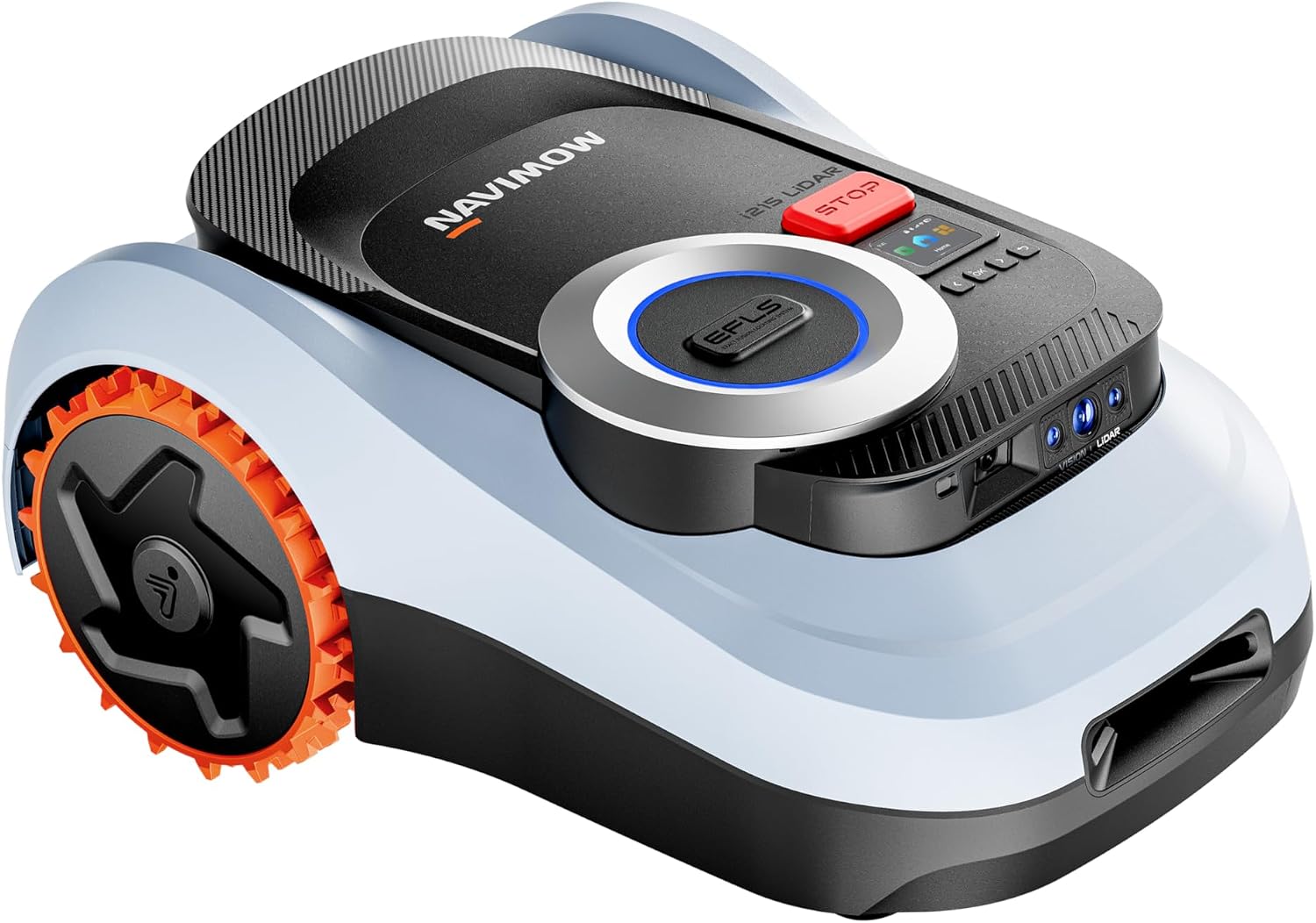
Our pick: Segway Navimow i215 LiDAR Robot Lawn Mower, Wire Free Robotic Lawn Mower for 0.37 Acre, LiDAR & Vision Dual Fusion, Auto Mapping, Off-Road Wheels for 45% Slopes, Quiet 59 dB(A) Mowing
 Visit on Amazon →
This is the mower I would put on a suburban lot with a real slope and no appetite for burying wire. The spec sheet is the reason: 0.37 acre of rated coverage, LiDAR and vision fused together instead of a satellite base station, off-road wheels listed for 45% slopes, and a 59 dB(A) noise figure that means you can run it early without a neighbor complaint. The wire-free part matters because it removes the one job most homeowners hate, which is trenching a boundary loop and then repairing splices every spring.
Check current Amazon price before you commit, because this is a system purchase, not an impulse buy.
Flaws but not dealbreakers: 0.37 acre is 0.37 acre. If your lot is bigger than that, you are buying a mower that will run all day and still leave stripes. LiDAR also wants a boundary it can see, so a lawn that fades into an open field with no fence, hedge, or bed edge will need help from you in the form of stakes or a defined edge. And wire-free does not mean installation-free. You still set the dock, and you still supervise the first map.
Anyone with a quarter-acre to a 0.37-acre yard, a slope, and trees that would kill a satellite signal should start here.
The actual install workflow
This works for any wire-free mower. The steps are the same whether you are standing in my yard or yours.
Step one: Stake the boundary before you charge anything. Walk the edge of the lawn with string and stakes and mark where you want the mower to stop. This is not optional. Every no-go zone you forget, the mower will find, usually at the worst possible moment. You want the boundary about a hand's width outside the actual grass edge so the mower can turn without shaving the bed.
Step two: Clear the lawn like you mean it. A robot mower does not mulch dog toys, extension cords, or fallen branches. Walk the whole area and pick up everything. I do this twice: once a week before the mower arrives and once the morning of the first run. The mulberry-leaf clog of 2024 taught me that a mower will happily eat a pile of wet leaves and then sit there sulking.
Step three: Put the dock where the power is. Level ground, within reach of an outdoor outlet, with clear runway in front of it. Not under the low branch of the maple, not at the bottom of the slope where water collects, not in tall grass. If you can see the dock from the kitchen window, put it there, because you will want to check on it for the first month.
Step four: Let it map, and walk behind it. Auto mapping sounds hands-off. It is not. Walk the perimeter behind the mower on the first run and watch what it registers as an obstacle. This is where you learn whether the sensors actually agree with your lawn, and it is where you catch the bed edge you forgot to mark.
Step five: Start the cutting height high. A robot taking over from a weekly gas mower will shock the grass if it takes too much off. Set the deck high for the first two weeks, then drop it a notch and let it work down.
Step six: Set no-go zones for beds, the garden, and the dog's toy pile. The garden is the big one for me. A mower that clips the edge of a perennial bed once will do it every single day until you fix the boundary.
Step seven: Schedule daily, not weekly. Mowing frequency beats mower quality every time. A modest robot running every day beats an expensive one running on Saturdays. Small clippings, cut often, break down and feed the lawn instead of smothering it.
Step eight: Test the slope wet, not dry. Wait for a rainy day and send it up the steepest line. If the wheels slip or the mower slides sideways, change the direction of approach so it climbs on the diagonal, or fence the slope off and mow that strip yourself.
Step nine: Plan winter storage now. Clean the deck, pull the battery inside if the manual says to, and store the dock where snow will not bury it. Minnesota will test this for you whether you plan for it or not.
The gear in the shed
This part is not mower gear, and I will say so up front. Every fall, when the mower goes into storage and the garden comes in, clients ask me what to do with the harvest. I garden as much as I mow, and a pressure canner is the appliance that turns a September glut into February dinners. If you are not canning, skip to the next section.
The off-season pick: Presto 02153 23-Quart Digital Pressure Canner
 Visit on Amazon →
Twenty-three quarts is a big canner, and big is the point. It holds a full load of quart jars in one run, which matters when the whole tomato crop ripens in the same week and the chest freezer is already full. The digital control is the part that changed my mind about this class of appliance: a dial gauge you have to read and adjust is a skill, and a digital controller takes most of that skill out of the equation for people who can two or three weekends a year.
Check current Amazon price before you buy, and read the manual before the first batch.
Flaws but not dealbreakers: It is heavy when loaded, so it needs a sturdy burner and a counter that can take the weight, plus real stovetop clearance for the lid. This is not a small-apartment appliance, and it is not a decorative one either. Follow the manufacturer's instructions and current USDA guidance for your altitude and your food, every single time.
Anyone with a garden, a full freezer, and a free weekend in September will get their money back out of it.
What I did not pick, and why
Three categories get recommended to people reading about robot mowers, and none of them belong in this guide.
Satellite-only mowers. RTK is elegant and it fails under tree cover. I have watched a mower with a clear view of the sky lose its fix under a maple canopy in August and sit there. If your lawn is an open field, RTK is fine. If you have mature trees, the LiDAR and hybrid machines are the safer buy, and that is the whole reason the pick above leads this article.
Pure wire systems. I still install wire for clients who want the most boring, most predictable setup available, and it works. But this is the wire-free path, and the tradeoff is honest: you give up the certainty of a physical boundary and you get a weekend of trenching back.
Zero-turn mowers and lawn chemicals. Different machine, different buyer, and I do not give chemical advice. If you want a riding mower comparison, that is a different article by a different person.
What the install really costs
The purchase price is the easy part, and it is on the listing, so I will not guess at it here. What people underestimate is everything around it.
- The first weekend. Staking, mapping, dock setup, and the first supervised run is a full day on a simple yard and a full weekend on a yard with beds, slopes, and a dog.
- Blades. Blade life is the hidden cost of robot mowing. Dull blades tear grass instead of cutting it, and you will see it at the tips within a month of hard use. Buy spares before you need them.
- Power at the dock. If there is no outdoor outlet near where the dock has to sit, you are paying an electrician, and that cost has nothing to do with the mower.
- Slope repairs. If the mower slides on your hill, you will spend money on edging, a retaining strip, or grass repair. Nobody budgets for this one.
The math that matters is not the purchase price. It is the number of days per season the mower actually runs. A mower that runs daily from May to October is doing 150 cuts. A mower that gets stuck twice a week is doing nothing but teaching you to hate it.
Set the dock level, stake the boundary, walk the first map behind the mower, and start the deck high. Then let it run every day and forget about it. That is the whole trick. The robot is the easy part. The lawn was always the project.