I have installed more than 30 robot mowers on client lawns around Minneapolis, and the lesson that keeps repeating is that the spec sheet is a marketing document while the install is the actual product. Wire-free robot mowers are the current pitch, and it is a good pitch, because perimeter wire is the real cost of owning one of these machines: the spool, the stakes, the splice that corrodes by the second season, and the Saturday you lose laying it around a garden bed. But wire-free is not automatically easier. It trades a physical boundary for a positioning system, and positioning systems have their own failure modes, which in my part of the country usually involves a maple tree.
My pick for most half-acre suburban lawns is the Husqvarna 410iQ, the YARBO Pro is the machine for genuine acreage, and the YARDCARE M800Plus is the value play that hedges its GPS with a physical boundary stripe. The Samsung Galaxy Tab A11 is in the table for a different reason, and I will explain it below, because every mower here is app-controlled and the screen question is real.
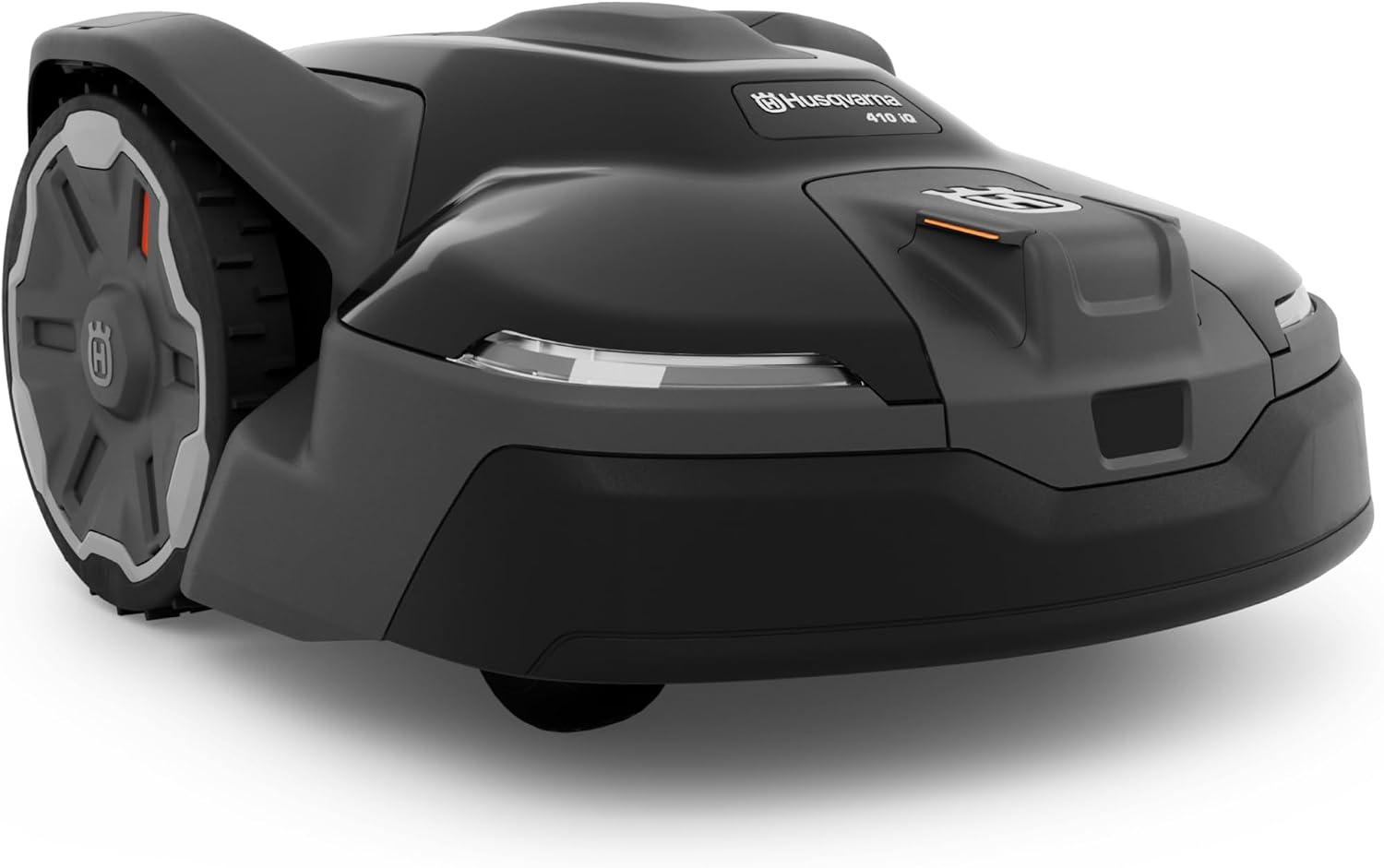
Husqvarna 410iQ
The highest printed slope rating in this group at 45%, plus a half-acre ceiling that matches most suburban lots
Wire-free on a brand built on wire means you are trusting navigation under tree cover
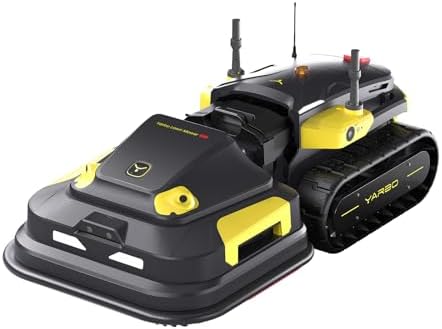
YARBO Robot Lawn Mower Pro
Six acres of headroom and four seasons of claimed yard care, so it is not a summer-only machine
Far more machine than a normal lot needs, and the most ground for positioning drift

Samsung Galaxy Tab A11
An 8.7 inch, 64GB screen you can leave near the dock instead of tying up your phone
It does not mow anything, and the international version listing deserves a close read
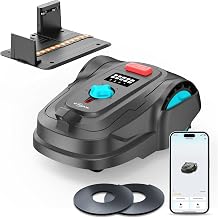
YARDCARE M800Plus
GPS and 3D vision plus a bundled 32.8 ft magnetic stripe, a physical hedge against pure GPS
Newest brand here with the thinnest reliability record and a very short stripe
Prices and availability were captured from Amazon Creators API and may change.
How I judge a wire-free mower
I am not going to pretend I have run all four of these machines through a Minnesota season, because I have not. What I have done is install and troubleshoot more than 30 robot mowers for clients, keep a string and stakes map of every layout, and store these things through two winters. That gives me a specific set of questions that a spec sheet can answer and a set it cannot.
The questions that matter, in order: how much lawn are you actually mowing, how bad is the slope, what is standing between the mower and the sky, and what happens when it cannot find the dock at dusk. Everything else, including whatever the manufacturer named its navigation system, is secondary.
Notice that perimeter wire does not appear on that list. That is deliberate. Wire is boring and it works, which is why I still install it for clients who want reliability. Wire-free is a genuine upgrade when the layout is open and the lawn is simple. It is a downgrade when the lawn is a maze of beds, sheds, and mature trees. The four products below sit at different points on that trade, and one of them is not a mower at all.
Husqvarna 410iQ: the half-acre wire-free pick
The 410iQ is a wire-free, app-based machine rated for a half acre with a 45% slope rating, and on paper it is the most conservative set of numbers in this table. That is a compliment.
Husqvarna has a decade of reliability data behind it in my installs, and the European brands are the ones I trust when a client asks what happens in year three. The half-acre ceiling is the sweet spot for suburban lawns. Most of the lots I work on are between a quarter and a half acre, and a mower sized to the top of that range is not straining to finish before the rain.
The 45% slope claim is the highest here, and while I do not trust printed slope ratings, a high number from a brand with this much history is worth more than the same number from a newcomer. Slope ratings are marketing, and I have watched a mower rated for 25% slide sideways on wet grass at 18%. What the higher rating tells me is that the drivetrain and traction design were built for grades, not flat turf.
The trade-off is the wire-free part. If your half acre is open, this is a clean install and you skip the worst day of the project. If your half acre is a wooded lot with a canopy over the dock, wire-free navigation is exactly where these systems get nervous.
Check current Amazon price for the Husqvarna 410iQ.
YARBO Pro: six acres and four seasons
The YARBO Pro is wire-free and rated for six acres, and it is positioned as four seasons yard care rather than a summer mulching machine. That acreage number is the headline, and it is worth reading twice.
Six acres is a property, not a lawn. If you own that much ground, most consumer robot mowers are not even in the conversation, and the alternative is a zero-turn and a lost weekend. This is the machine in the table that makes sense for a rural parcel, a small orchard, or someone who wants one platform doing more than cutting grass across the calendar.
The honest problem is that acreage is also exposure. Every additional acre is another acre where positioning can drift, another acre of tree line, another acre of grade. Wire-free navigation at six acres is a much harder engineering problem than wire-free navigation at half an acre, and the failure modes get more expensive when the mower is a quarter mile from the dock.
For a normal suburban lot, you would be paying for headroom you will never use. That is not a defect, it is a mismatch, and mismatch is the most common mistake I see people make. Buy the acreage you have, not the acreage you aspire to.
Check current Amazon price for the YARBO Robot Lawn Mower Pro.
YARDCARE M800Plus: the value end of the table
The YARDCARE M800Plus is the newest machine here, and its feature list is the longest: GPS and 3D vision, obstacle avoidance, auto-charging, app control, bow-shaped mowing, and coverage up to 8,611 square feet. It also ships with 32.8 feet of magnetic stripe.
The stripe is the interesting part, and it is the reason this mower is in the comparison at all. A physical boundary aid bundled with a GPS machine is a hedge, and hedges are exactly what I want on a mower from a brand without a long service record. GPS and 3D vision handle the open lawn. The stripe handles the one zone where you do not want the mower improvising, like a bed edge or a narrow pass between a fence and a garden.
Be realistic about the length. At 32.8 feet, this is a guide for a trouble spot, not a full perimeter. If you are imagining a wire-free mower that also gives you wire, you are getting a sample of it, not a spool.
8,611 square feet is a genuine suburban lot, and obstacle avoidance plus auto-charging covers the basics a buyer actually cares about. Bow-shaped mowing is a pattern choice rather than a spec, and I would not choose a mower on it.
What you give up is history. This is the newest brand in the table with the least data behind it, and the app is the great unknown, because the app is a feature and not the mower. If scheduling fails, the robot is a very slow Roomba. That said, the feature list per dollar here is the strongest of the three mowers.
Check current Amazon price for the YARDCARE M800Plus.
The Samsung Galaxy Tab A11: the control surface
Every mower in this table is app-controlled, which raises a question almost nobody asks at purchase: which screen runs the mower?
If the answer is your phone, the mower app lives next to your messages, your battery is shared with everything else you do, and you will be standing in the yard at 7 a.m. wanting to check a boundary map on a screen that just got a low battery warning. A cheap dedicated tablet solves that.
The Galaxy Tab A11 is a WiFi model with an 8.7 inch display, 64GB of storage, 4GB of memory, and the model number SM-X133, in gray. At 8.7 inches it is a reasonable size for a boundary map and a schedule list, and it is the kind of device I would mount in a garage or a shed without worrying about it.
Two caveats. It does not mow anything, so it is a companion purchase and not a mower alternative. And it is WiFi only, so if your dock sits at the back of the property outside your network's reach, a WiFi tablet will not help you there. The listing also identifies it as an International Version, which is a detail worth reading before you buy.
Check current Amazon price for the Samsung Galaxy Tab A11.
Where each one loses
The Husqvarna loses on canopy. Wire-free navigation under a mature maple is the exact scenario where I have seen positioning systems struggle, and this is a brand whose reputation was built on a physical wire. You are trading proven boundary hardware for convenience, and for an open lawn that trade is good.
The YARBO loses on fit. Six acres of capability on a quarter-acre lot is money spent on nothing, and the larger the coverage claim, the more moving parts the navigation has to keep straight. If you do not have the acreage, this is not the machine for you no matter how good it is.
The YARDCARE loses on track record. The spec sheet is the best value here, and the stripe is a smart hedge, but I cannot tell you what this brand's app looks like after a firmware update in year two, because there is not enough history. That is a real risk, and I would rather name it than pretend otherwise.
The Galaxy Tab A11 loses on scope. It is a screen. It solves the control surface problem and nothing else.
Slope ratings, RTK, and other marketing
Slope ratings are the number I trust least on any box. I have watched a mower rated for 25% slide sideways on wet grass at 18%, and I have watched cheap tires turn a good drivetrain into a toboggan. A 45% rating tells you the manufacturer designed for grades. It does not tell you the mower will hold a wet Minnesota hill in April.
The other phrase to treat carefully is wire-free. Wire-free usually means one of two things: a boundary system that uses satellite positioning, or a vision system that reads the lawn. Satellite positioning is elegant and fails under tree cover. Vision is clever and struggles with changing light and heavy leaf fall. The mowers that will win the next few years are hybrids that use a physical boundary for the tricky edges and positioning for the open middle. The YARDCARE stripe is a small version of that idea, and I expect the premium tier to follow.
On blades: blade life is the hidden cost of any of these machines. Cheap blades dull in a month and the robot starts tearing grass instead of cutting it, which is how you get a lawn that looks worse after you automated it. Budget for replacements the way you budget for string in a trimmer.
Which one I would install on your lot
If you have a half acre or less with an open sky and a grade, the Husqvarna 410iQ is the install I would recommend, because the slope rating and the brand history line up with the two things that actually break.
If you have multiple acres and want one machine working across seasons, the YARBO Pro is the only one here sized for that job, and the acreage is the reason to buy it.
If you have a normal suburban lot, want the longest feature list, and accept that you are an early adopter on the brand, the YARDCARE M800Plus is the value pick, and the bundled stripe gives you a fallback for the one corner where GPS tends to argue with you.
And whichever you choose, decide up front which screen runs it. Mowing frequency beats mower quality every time, and a mower you cannot easily schedule from the kitchen table is a mower that runs less often than it should.