Related: Best Robot Mower for a Small Yard With a Slope
Robot lawn mower setup is the product. The mower is only the machine that executes it. I have installed more than 30 of these for clients around the Twin Cities, and I have run six different robots through two full Minnesota seasons on my own 0.4 acre lot, which has one slope that turns slick in May, a perennial bed that must stay untouched, and a dog who treats a docking station like an intruder.
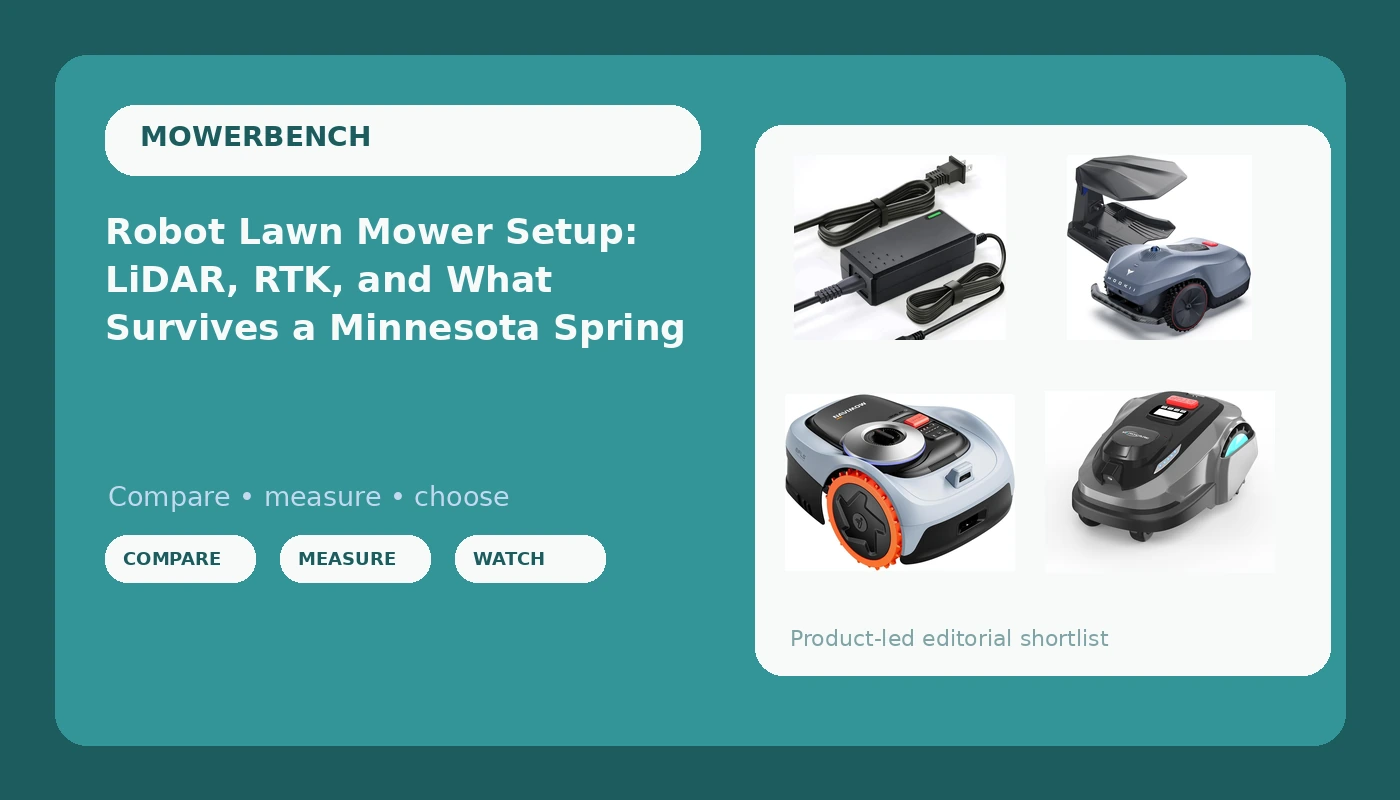
So when I read a spec sheet, I am not really reading about the mower. I am reading about the install: how the machine finds its boundary, how it gets home in the dark, how it behaves on the third rainy day in a row, and what breaks first. The four products below cover the three real navigation philosophies you can buy right now, LiDAR, RTK with vision, and RTK alone, plus the one part nobody budgets for until the charging base dies in July.
Here is how I would sort them for a real yard, not a showroom floor.
Best for Big Yards: Neomow X SE
The Neomow X SE 360° 3D LiDAR Navigation Robot Lawn Mower is the machine I would point a client toward when the yard is big and the tree canopy is thick. It navigates with a 360 degree 3D LiDAR array and it is rated for lawns up to 0.75 acre. That is not a starter yard. That is a real lawn with a couple of zones, a shed to dodge, and a corner where the grass never quite dries.
LiDAR is the answer to the complaint I make most often. In my installs, RTK mowers are the ones that lose their position under a maple canopy or along the north side of a garage, and when the fix drops, the robot either stops or starts wandering. LiDAR does not need a satellite. It maps what it can see, which means shade is not the enemy.
What I would verify before committing is the low, flat stuff. A hose, a dog toy, a garden edging stone that sits flush. LiDAR sees shapes, and a dark object lying flat on wet grass is the hardest thing for any of these systems to read. Ask about low obstacle behavior, and keep the first two weeks boring. Clear the yard, watch where it hesitates, and adjust from there. The 0.75 acre rating also means long run times, so think about where the dock lives and whether that spot gets afternoon shade.
For: a third of an acre up to 0.75 acre, mature trees, no appetite for burying wire. Not for: a postage stamp lawn where you would be paying for capacity you never use.
Best for Steep, Small Yards: Segway Navimow i206 AWD
The Segway Navimow i206 AWD is built for the yard I get called about most: a small city lot with one bank that nobody wants to mow. It is rated for 0.15 acre and slopes up to 45 percent, and it is all wheel drive.
Let me be honest about slope ratings, because I have watched a mower advertised at 25 percent slide sideways on wet grass at 18 percent. The number on the box is measured on a surface that does not exist in Minnesota in April. What matters more than the rating is the drive system and the tires. All wheel drive on a small, light robot is the difference between a machine that holds a line on a bank and one that digs itself a rut. On a 0.15 acre lot, the robot is also small enough that you can carry it back to the dock when it misreads the hill, which is not true of the big machines.
The other advantage of a small rating is frequency. A robot sized for a small lawn can run daily without complaint, and daily cutting is what actually improves a lawn. Mowing frequency beats mower quality every time. A modest robot running every day out-cuts an expensive one running once a week, and it never leaves clippings long enough to mat.
For: a small lot with a steep bank, a tight gate, and a homeowner who wants the hill handled. Not for: anything approaching half an acre. You would be running it constantly.
Best Wire-Free Value: YARDCARE N1600 PRO
The 2026 New YARDCARE N1600 PRO is the one that matches a prediction I have been making for a couple of seasons. RTK alone is elegant and it fails under tree cover. Wire is boring and it works. The market was always going to settle on a hybrid, and this machine is that hybrid: RTK plus 3D vision, no boundary wire, and a rated lawn size up to 0.4 acre.
The 3D vision layer is the part that matters. When the RTK fix gets shaky, a camera-based system can still see where it is and keep working, which is exactly the failure mode that makes people give up on wire-free mowers. It also handles the multi-zone scheduling that a real yard needs, since most 0.4 acre lots are not one open rectangle. They are a front strip, a back yard, a side yard along the driveway, and a garden bed you want the robot to treat as a wall.
What I would test in the first month: does the map survive a firmware update, and does it still find the dock after dark. Those two failures account for more of my client calls than blade wear and mud combined. A robot that loses its map is a very slow Roomba. A robot that cannot dock is a paperweight with a battery.
For: 0.2 to 0.4 acre, multiple zones, tree cover, and a homeowner who does not want to trench wire. Not for: someone who wants a decade of reliability data behind the badge. The European brands still own that argument.
The Part Nobody Plans For: Replacement Charger
This one is not a mower. It is the 3-Pin Charger for Mammotion LUBA 1 2 3 AWD 3000 5000 10000 X HX Robot Lawn Mower Charging Base Power Supply Adapter Replacement, and it belongs on this page because the charging base is the least romantic and most failure-prone part of the whole system.
Think about what the power supply does. It sits outside, in a docking station, through rain, snow melt, and the freeze-thaw cycle that turns a Minnesota March into a demolition crew. It is a sealed power brick living the worst life of any component you own. When it fails, nothing on the app tells you the brick is dead. You get a robot that parks at the dock and does not charge, and you spend a weekend testing everything else first.
If you own a LUBA, keeping a replacement charger on a shelf is cheap insurance against a dead lawn in the middle of the growing season. It is also the part I would buy before I needed it, because the failure always happens on a Friday.
For: LUBA owners who would rather not wait a week for a part in June. Not for: anyone who does not own a compatible Mammotion machine.
How I judge a robot mower before it touches my lawn
I keep a string and stakes map of every install, and I score each machine on the same six things.
Navigation and recovery. Does it hold a boundary, and what does it do when it loses position? RTK drops under canopy. LiDAR struggles with low, flat objects. Hybrid systems hedge.
Dock finding in the dark. If a robot cannot park at 9 pm in October, it is not a robot, it is a chore.
Slope behavior on wet grass. Not the rating. The tires and the drive.
Blade access. If replacing blades needs a special tool, the blades will not get replaced, and a dull blade tears grass instead of cutting it. Torn grass tips go brown, and that is how a robot mower gets blamed for a lawn problem it did not cause.
App stability. A map that survives firmware updates is worth more than any feature list.
Install hours. Wire means a weekend with a spade and a lot of swearing. Wire-free means a mapping run and a boundary you teach it. That trade is the actual purchase decision.
The reference table
| Product | Yard it fits | Navigation | Install reality | Price |
|---|---|---|---|---|
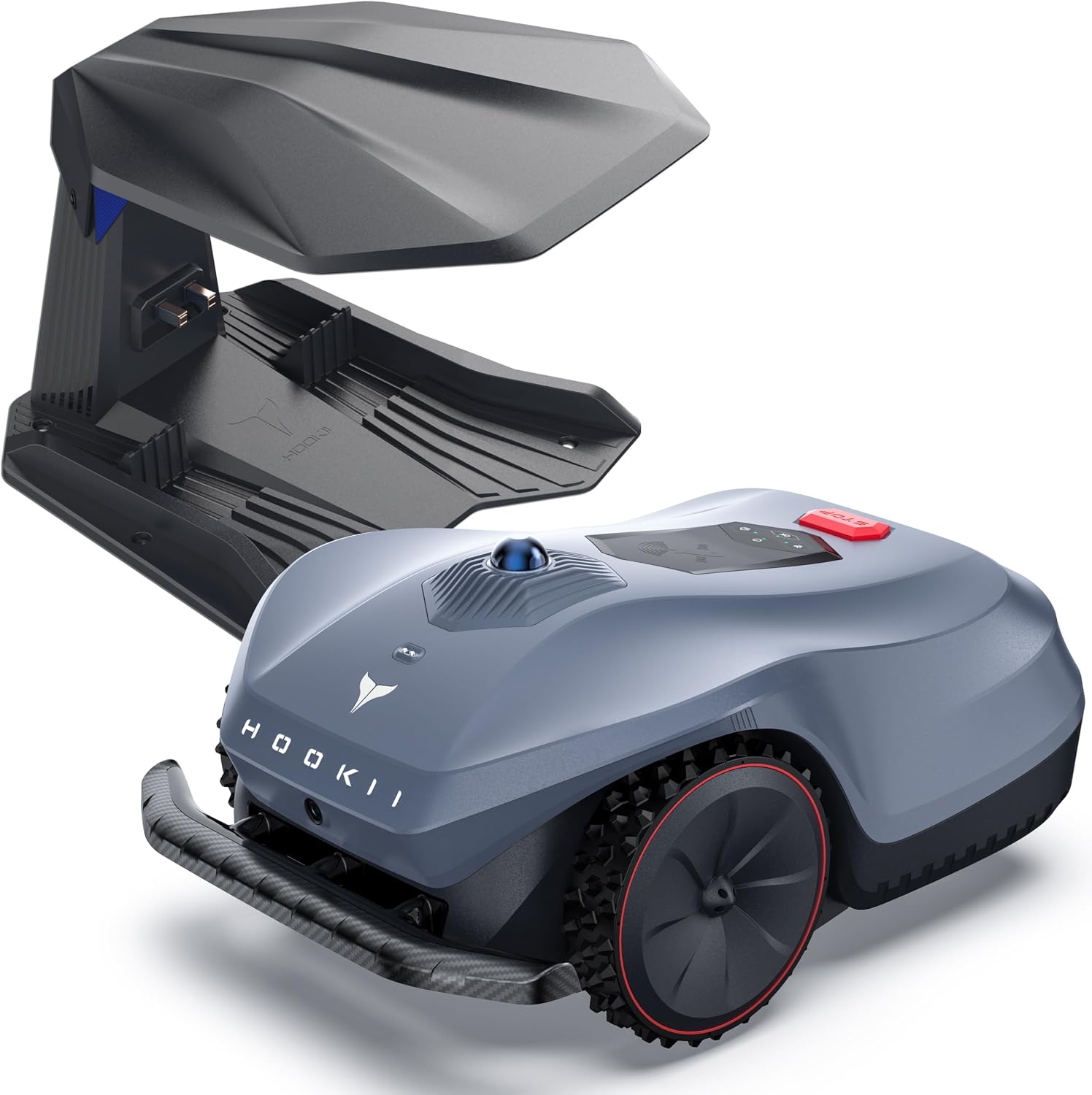 Visit on Amazon → Visit on Amazon →Neomow X SE 360° 3D LiDAR Navigation Robot Lawn Mower |
Up to 0.75 acre | 360° 3D LiDAR, no boundary wire | No trenching, no satellite dependency, watch low flat obstacles | $999.00 |
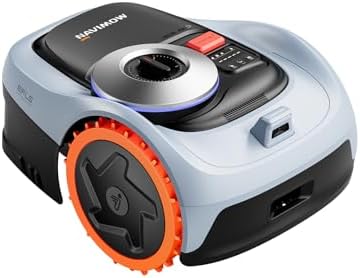 Visit on Amazon → Visit on Amazon →Segway Navimow i206 AWD Robot Lawn Mower |
0.15 acre | RTK based, all wheel drive | Best pick for a small steep city lot, run it daily | Check current Amazon price |
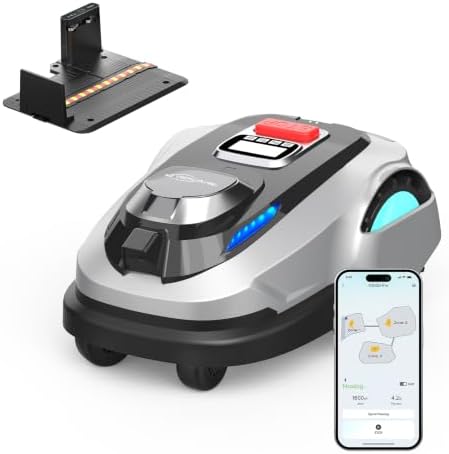 Visit on Amazon → Visit on Amazon →2026 New YARDCARE N1600 PRO Robotic Lawn Mower |
Up to 0.4 acre | RTK plus 3D vision, no boundary wire | Hybrid navigation, multi-zone app scheduling, check map retention | Check current Amazon price |
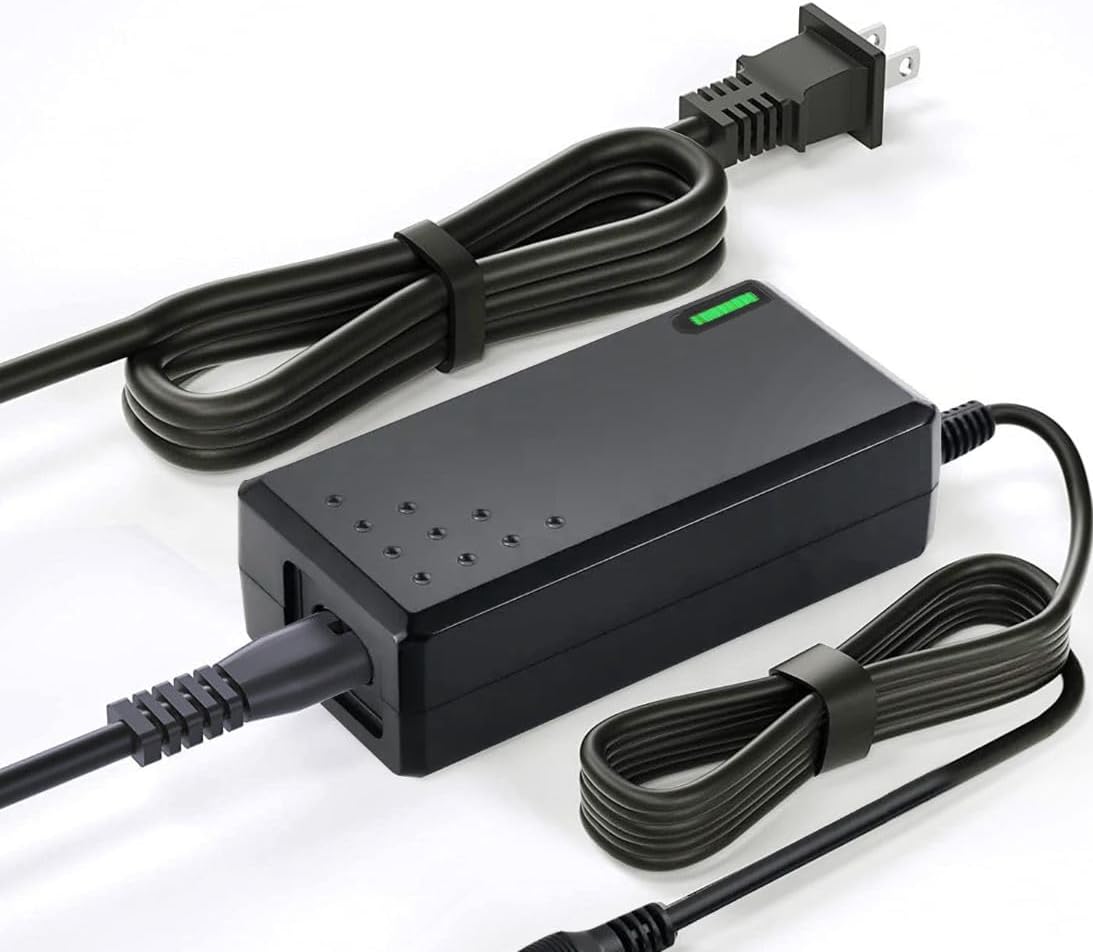 Visit on Amazon → Visit on Amazon →3-Pin Charger for Mammotion LUBA Charging Base Power Supply Adapter Replacement |
Not a mower | Charging base power supply | The spare part that saves a season when the dock dies | $116.99 |
What the specs actually mean in a real yard
Read the table as a set of tradeoffs, not a ranking. Capacity is the first filter. The Navimow i206 is a 0.15 acre machine. If your lawn is 0.5 acre, it will run all day and never finish, and you will conclude that robot mowers are useless. The YARDCARE covers up to 0.4 acre. The Neomow X SE covers up to 0.75 acre. Buy for the lawn you have, not the lawn you want.
Navigation is the second filter, and it is the one that decides whether you enjoy owning this thing. RTK gives you precise, repeatable lines and a tidy stripe pattern, and it depends on a clear view of the sky. Under my maples, that view is a rumor for six months of the year. LiDAR gives you independence from the sky and a machine that reads its surroundings instead. The hybrid in the middle, RTK plus vision, is where I think most buyers should land, because it keeps the precision and adds a fallback for the moment the fix drops.
The third filter is the one nobody puts on the box: what happens when the dock fails. That is why the replacement charger is on this page. The power supply lives outdoors year round, and it is the component I would expect to give out first. Owning the spare is the difference between a two day inconvenience and a three week dead lawn in July.
And the fourth filter is frequency. Every machine here is capable of running daily, and daily is how you get the result you want. Short clippings, no matting, no bagging, no raking. The robot is not the improvement. The schedule is.
Should you buy the Neomow X SE?
Yes, if your lawn is bigger than a third of an acre and you have trees. LiDAR takes the single biggest risk out of wire-free mowing, which is losing your position under a canopy, and 0.75 acre of capacity means it finishes the job with time to spare. The thing I would hold it to is low obstacle behavior. Clear the yard, watch the first two weeks, and be patient with the mapping. If you want a big yard cut without burying a wire, this is the one to study.
Should you buy the Segway Navimow i206 AWD?
If you have a small lot with a bank that you dread, yes. All wheel drive and a 45 percent slope rating are aimed directly at the yard where a lighter two wheel drive robot slides sideways in wet spring grass. Just respect the 0.15 acre capacity. This is a machine for a tight property, and on a tight property, a robot that runs every day will quietly out-perform a much more expensive machine that only runs when you remember to schedule it.
Should you buy the YARDCARE N1600 PRO?
Yes, if you want wire-free without putting all your faith in satellites. RTK plus 3D vision is the compromise I have been expecting, and 0.4 acre with multi-zone scheduling fits the way suburban yards are actually shaped. Ask the two questions I always ask: does the map survive a firmware update, and does it dock in the dark. If the answers are yes, this is a lot of machine for a mid-size lawn.
Should you buy the replacement charger?
Only if you own a compatible Mammotion LUBA machine, but if you do, buy it before you need it. The charging base power supply is the part that lives outdoors through everything, and a mower that cannot charge is not a mower. A spare on the shelf costs less than a month of a lawn service.
The bottom line
Match the machine to the lawn and the navigation to the trees. If you have canopy and size, the LiDAR machine is the safe bet. If you have a small steep lot, all wheel drive matters more than any feature on a spec sheet. If you want wire-free with a safety net, the RTK plus vision hybrid is where the market is heading anyway. And whatever you buy, budget for the dock, because that is the part nobody thinks about until it fails on a Friday in July.