Wire-free robot mower setup lives or dies on two decisions you make before the mower ever leaves the dock: where the charging station sits, and how much open sky your yard actually offers. Get those right and everything after is scheduling and blade swaps. Get them wrong and you will spend the season rescuing a robot that cannot find home in the dark.
I am Ingrid. I have installed more than 30 robot mowers for landscaping clients around Minneapolis, and I have run six of my own through two full Minnesota seasons, including winter storage, spring mud, dog interference, and the mulberry leaf clog of 2024. I keep a string-and-stakes map of every install, because the map is what tells me six months later why a mower keeps nosing into the same corner of the same bed.
A robot mower is a lawn system, not an appliance. The mower is just the part that moves. If the install is sloppy, the fanciest navigation package on the market will still park itself in the rhubarb.
Why you should trust me
I came to this from the dirt side. Fifteen years installing lawns taught me how turf actually grows, and the last several years of robot mower reviews taught me how badly marketing slope numbers match wet grass. I have watched a mower rated for a "25% slope" slide sideways on an 18% grade after a rain, with the rear wheels spinning and the app cheerfully reporting that everything was fine.
I install perimeter wire for clients who want boring reliability, and I test wire-free and RTK systems on my own lot because that is where I learn the failure modes. My dog chases anything that moves, my lot has a genuine slope, and my spring is mud. That combination is a better durability test than any showroom.
What I check before I recommend a wire-free mower
Navigation first. RTK positioning needs a clear view of the sky. It is elegant and it fails under a maple canopy, so I walk the yard with the client and mark every spot that sits in shadow for most of the day. A vision system that reads the lawn edge is less fragile under trees, but it still needs a boundary that looks like a boundary, which means no ragged edges creeping into the beds.
Slope second, and this is where I get loud. Slope ratings are marketing until you know whether the number is a percentage or a degree. A 100% slope is 45 degrees, which is steeper than most residential yards. A 45% slope is roughly 24 degrees, a serious but common grade. When two spec sheets look similar and one says percent and the other says degrees, they are not the same claim at all.
Dock placement third. The dock needs power, level ground, decent sky, and a location that lets the mower approach from more than one direction. A dock jammed against a fence corner with a single approach path is a mower that fails to park.
Cutting height fourth. A wide height range matters more than people think, because a Minnesota spring wants a tall first cut and a July lawn wants a short one. Frequency beats height, though. A cheap robot running daily beats an expensive one running weekly. Every time.
Blades fifth. Blade life is the hidden cost of ownership. Dull blades tear grass instead of cutting it, and the torn tips brown out and invite fungus. If a blade swap needs a special tool from the manufacturer, that is a design decision I hold against the mower.
Which mower fits which yard
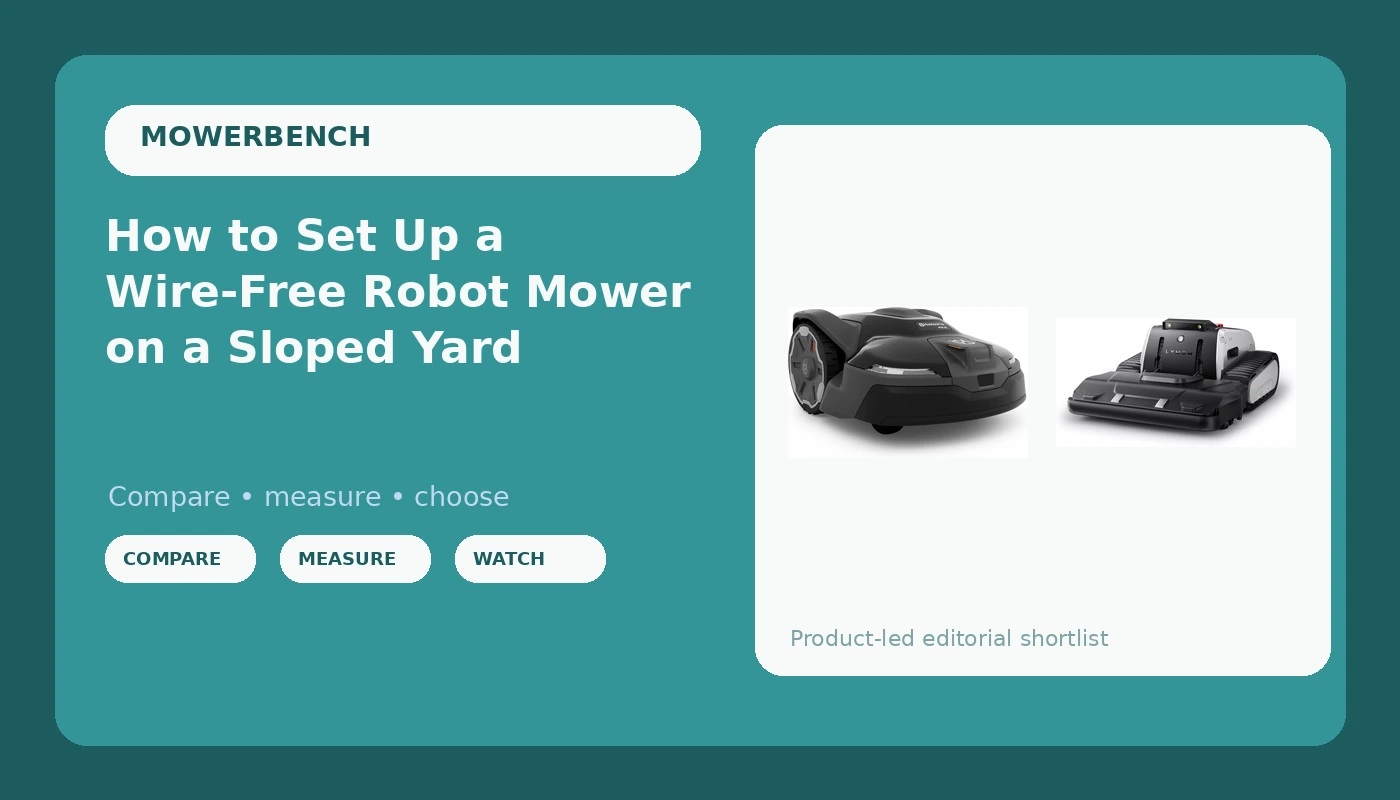
These two are the ones I would put on a short list for a wire-free install, and they sit at different points on the scale. One is built for the classic half-acre suburban lot with a real slope and a house full of smart-home gear. The other is built for acreage, rough ground, and grades that make most mowers quit.
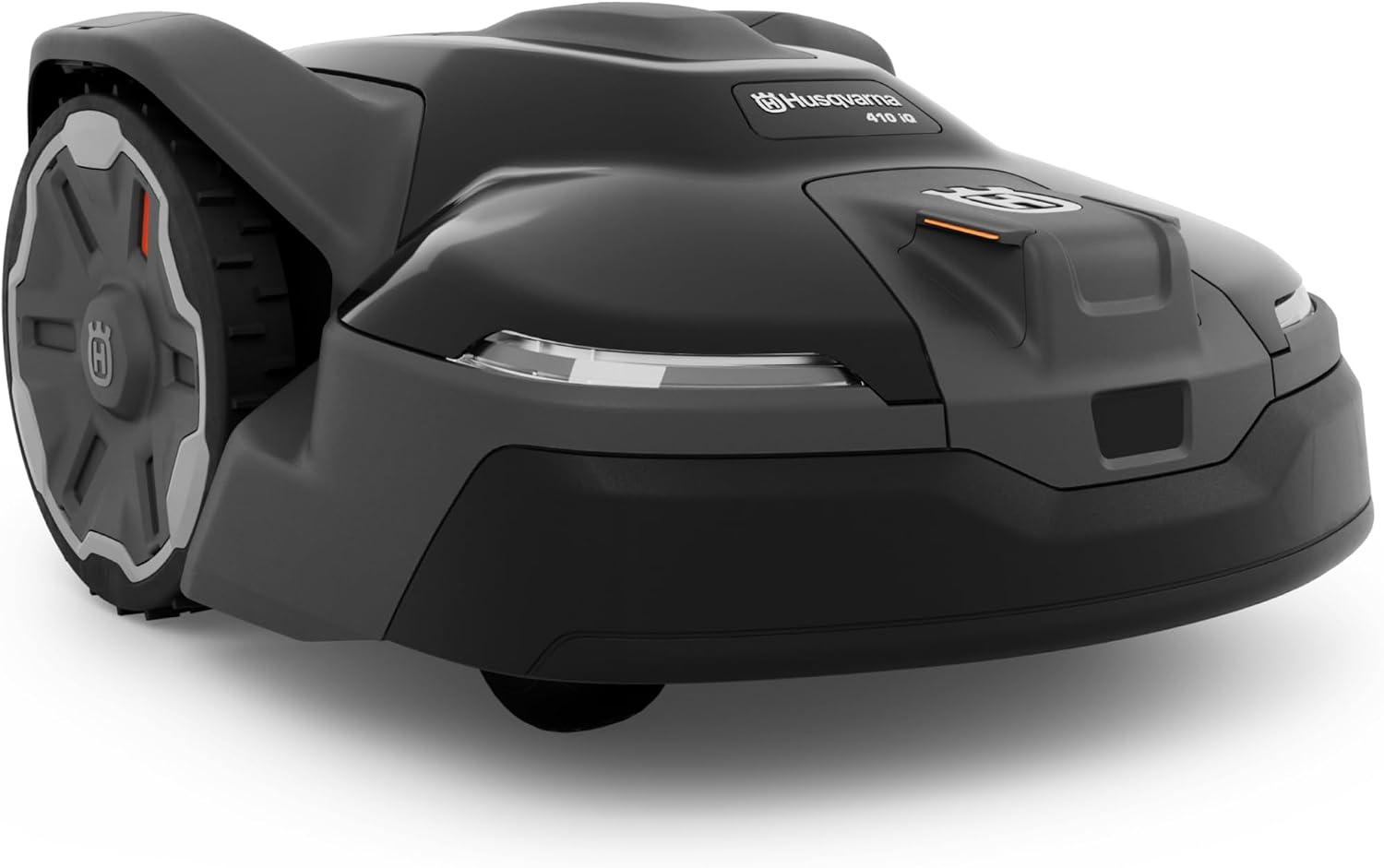
The half-acre suburban pick: Husqvarna 410iQ ½ Acre Wire-Free, 45% Slope, app Based, Robot Lawn Mower
 Visit on Amazon →
Check current Amazon price before you order.
This is the mower I recommend when a client has a quarter to a half acre, a slope that is real but not ridiculous, and zero appetite for burying wire. Wire-free means you skip the perimeter wire and go straight to mapping, which saves a weekend of stapling and splicing. The 45% figure on the box is a percentage, not a degree, so treat it as a capable but not extreme climber. Put it on dry grass and it holds. Put it on a wet grade in April and even the best traction math gets interesting.
The app is the reason this one earns its place on the short list. Scheduling is the single feature that decides whether a robot mower is useful or decorative, and a mature app is worth more than a couple of extra navigation sensors. Set a daily schedule, adjust for rain, and let it run. Half an acre of daily cutting keeps clippings small enough that you never see them.
Flaws but not dealbreakers: Wire-free navigation still depends on a sky view and a clean map. If your yard is hemmed in by mature trees on three sides, map the open zone carefully and expect to babysit the first few runs. This is also a mower for a defined lawn, not for a property with a dozen separate garden rooms to hop between.
Anyone with a half acre or less, a moderate slope, and a smart-home habit will get along with this mower from the first week.
The acreage and terrain pick: Lymow One Plus Robot Lawn Mower, Wire-Free RTK+Vision Navigation, 1.73 Acres Daily Coverage, 100% Slope (45°) Climbing, 1.2"-4" Cut Height, AWD All-Terrain Automatic Robotic Mower, App Control
 Visit on Amazon →
Check current Amazon price before you order.
This is the one for the property that has been fighting you. The slope claim here is written as 100% slope, which is 45 degrees, and it is paired with all-wheel drive. That combination is the difference between a mower that survives a steep bank and a mower that decorates the bottom of it. If your yard has a berm, a ditch, or a grade that makes you nervous on a riding mower, this is the class of machine you are shopping in.
The navigation is the interesting part: RTK plus vision, working together. That is the hybrid approach I expect the whole market to settle on, because RTK alone folds under tree cover and vision alone struggles with a uniform sea of green. Pair them and each covers the other's blind spots. You still need sky, and you still need to map carefully, but you have a second sense working for you when the first one gets confused.
Coverage is the other headline. 1.73 acres of daily coverage is genuine acreage territory, not a half-acre lot with delusions. The cutting height range of 1.2 to 4 inches covers a tall spring first cut down to a tight summer cut. All-terrain AWD with a cut that wide means this machine is built for ground that is not a smooth bluegrass carpet. Some properties need that.
Flaws but not dealbreakers: More machine means more to set up. The map drive takes longer, the dock placement matters more, and the app has more settings to get wrong on day one. Give yourself an afternoon, not 30 minutes. It is also more mower than a small flat lot needs, and buying capacity you will never use is how people end up disappointed in a perfectly good machine.
Anyone with an acre or more, real elevation change, or rough ground will find this is the one worth the setup time.
The install, step by step
This is the order I work in. Do not shuffle it.
Step one: Walk the yard and mark the sky. Take a phone and photograph the yard at three times of day. Mark every area that sits in shadow through the middle of the day. That is your RTK trouble zone, and it decides where the dock goes and where the map will be soft.
Step two: Pick the dock site. You want level ground, a power outlet you are willing to dedicate, and as much open sky as you can get. Do not tuck it under the deck. Do not put it in the one corner where the mower has to reverse out into a hedge. Aim for at least two open approach directions and enough clearance that the robot is not threading a needle every time it comes home in the dark.
Step three: Mow the yard yourself, once. Set your walk mower low and knock the lawn down before the robot ever starts. A robot dropped into four inches of spring growth will choke, and the first impression of the machine will be a bad one. Give it a fresh, even surface to learn.
Step four: Clear the lawn of everything. Dog toys, hoses, garden tools, extension cords, the sprinkler you forgot. Then handle the fixed obstacles: trees, beds, the swing set legs. Mark the no-go zones in the app before the first mapping run, not after the mower has already found them.
Step five: Map the boundary by driving it. Go slow. Follow the actual edge of the lawn, not the edge of the grass you wish you had. Ragged boundaries confuse vision systems, so trim the bed edges first and map the line you want the mower to respect all season. If you rush the map, you will be redoing it in June.
Step six: Set the cutting height high and work down. Start at the top of the range and drop a quarter inch a week until you reach your target. Scalping a lawn in one pass invites weeds and stresses the turf.
Step seven: Schedule daily, short, and in the middle of the day. Frequency is what makes this work. Daily cutting produces clippings small enough to disappear into the canopy, which is free fertilizer. Midday runs let the dew burn off first, because wet grass is where traction claims go to die.
Step eight: Set the rain delay and the weather rules, then leave them alone. Constant fiddling with the schedule is the fastest way to convince yourself the mower is unreliable. Pick a schedule, run it for two weeks, then adjust once.
Where wire-free goes wrong
The honest case against wire-free is tree cover. RTK is a satellite fix, and satellites do not see through a maple canopy. If a third of your lawn sits under mature trees, a plain RTK mower will drift, stop, and hunt. That is why I still install perimeter wire for clients who want reliability and nothing else. Wire is boring. Boring works.
The second failure mode is assuming wire-free means install-free. It does not. You trade a weekend of stapling wire for an afternoon of mapping, dock placement, and zone setup, plus a first month of watching the machine learn. That is still a good trade for most yards. It is just not zero effort.
The third is buying below the floor. The cheap end of this category is not a smaller version of a good mower. It is a different product with weaker navigation, thinner blades, and an app that has not been finished. A mower that needs rescuing twice a week is not saving you anything.
The upkeep nobody mentions
Blades are the real consumable. Plan on checking them monthly during the growing season, and sooner if the lawn starts to look frayed at the tips rather than cleanly cut. Swap them when they dull. Do not wait for the cut quality to collapse.
Keep the dock clean. Grass clippings pack into the charging contacts and the mower starts missing charges, which looks like a navigation bug and is actually a hygiene problem. Same with the underside of the deck. Rinse it, scrape it, and check that the deck spins freely.
Do your firmware updates in the off season, not mid-July. An update can reset the map, and rediscovering that in the middle of a growing week is a bad afternoon. And when winter comes, store the mower and the dock indoors, dry, off the ground, and charge the battery to the level the manual recommends before you put it away.
What this all costs
Both of these sit in the tier where a robot mower stops being a novelty and starts being a lawn system. Check current Amazon price on each and compare it against what you are actually paying now: fuel, oil, spark plugs, the small engine service you keep putting off, and the hour of your Saturday that you will never get back.
The ongoing costs are the same for either machine, and they are the ones people forget. Replacement blades through a season. A dedicated outlet or an outdoor outlet install if your dock site does not have one. A little electricity. Nothing here is dramatic, but a mower with no blade budget is a mower that will tear your lawn by August.
The math that matters is not the sticker. It is whether the machine runs most days of the season without you thinking about it. A mower that runs daily beats a better mower that sits in the garage because the schedule frustrates you. Set the install up properly once, and the mower earns its keep from April to November.