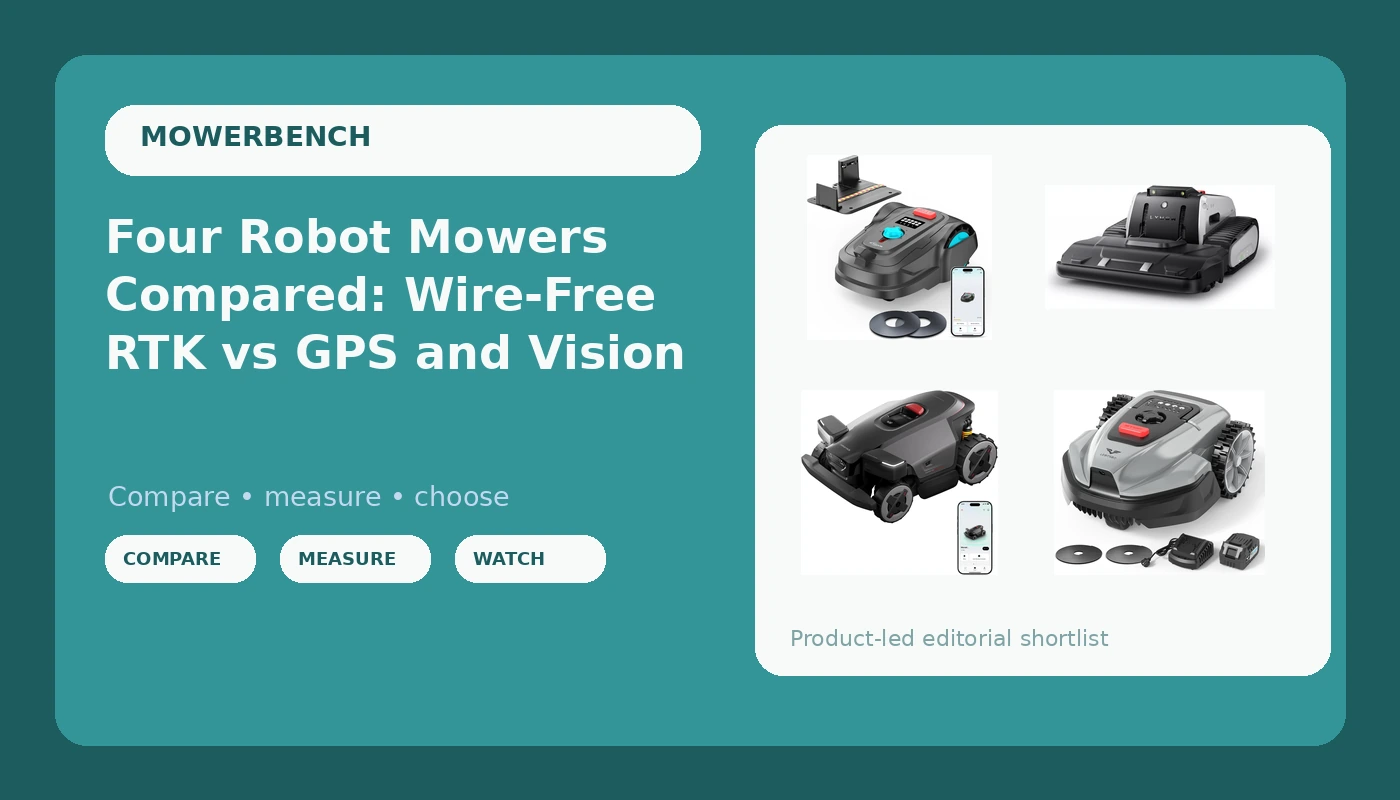
I have installed more robot mowers than I have owned. Thirty-plus client installs, six machines through two full Minnesota seasons, and a string-and-stakes map on my shop wall that I redraw every spring. That history is why this robot lawn mower comparison does not open with battery chemistry or app screenshots. It opens with the install, because the install is the product. The mower is just the robot that executes it.
The short answer: for a typical quarter- to third-acre suburban lot, the roborock RockMow X115H has the most complete navigation stack in this group. The YARDCARE M800Plus is the value play if your lawn is bigger and your sky is open. The Lymow One Plus is the machine I would put on a steep, messy, acre-plus property. And the V3 AI Vision is a starter mower for a small, simple yard, no more and no less.
Four mowers, four different answers to the same question: how does the thing know where it is? That question decides your install day, your spring, and whether you are still happy with it in October.
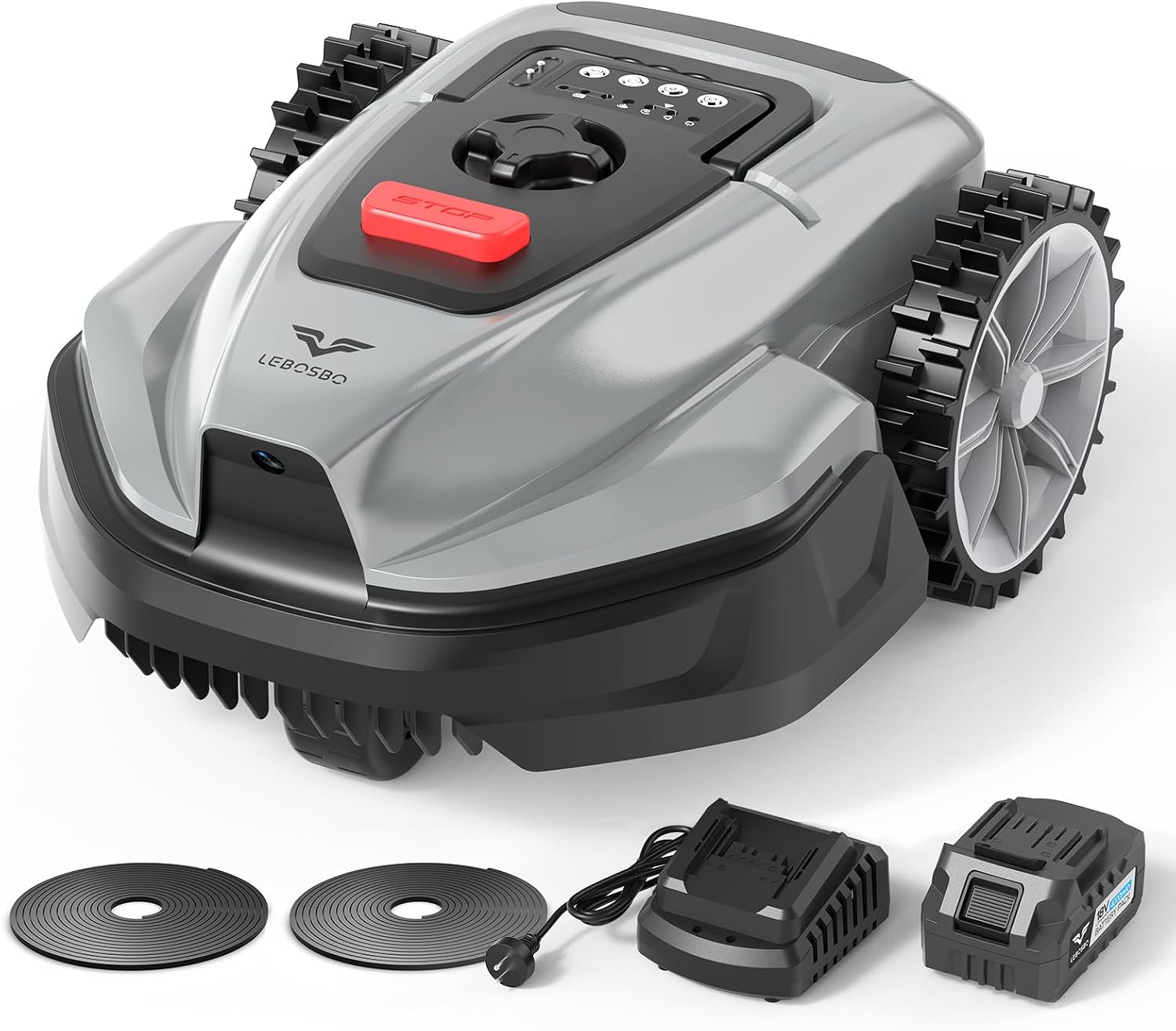
V3 AI Vision Robotic Lawn Mower, 1600 Sq.Ft, Black Silver
Lowest barrier to entry in this group, vision-led navigation, no perimeter wire or RTK antenna to plan around
A 1,600 sq ft coverage figure is a courtyard, not a property, and no slope rating is published
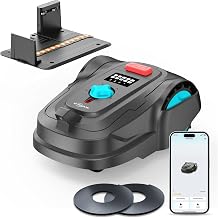
YARDCARE 2026 New M800Plus Robot Lawn Mower, GPS and 3D Vision
Up to 8,611 sq ft of coverage, GPS plus 3D vision, bow-shaped mowing pattern, ships with 32.8 ft of magnetic stripe
32.8 ft of stripe will not enclose an 8,600 sq ft lawn, and cutting height is not published
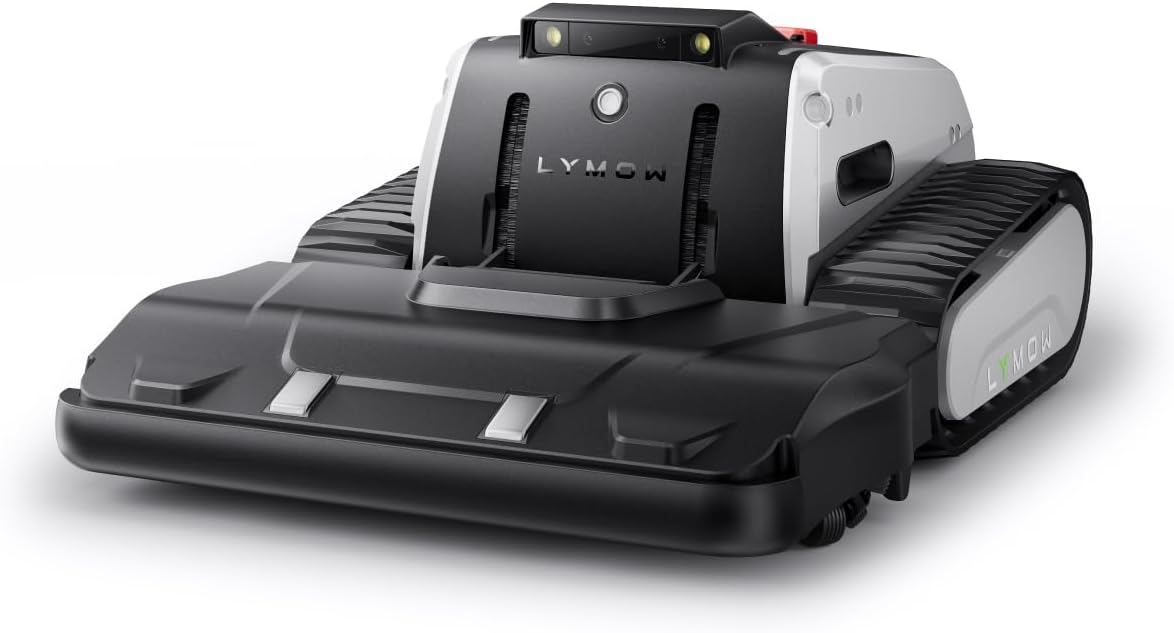
Lymow One Plus Robot Lawn Mower, Wire-Free RTK and Vision, AWD
1.73 acres of daily coverage, AWD, RTK plus vision, and a 1.2 in to 4 in cutting height range for tall spring grass
The 100 percent (45 degree) slope claim needs real-world verification, and wire-free means RTK sky view matters
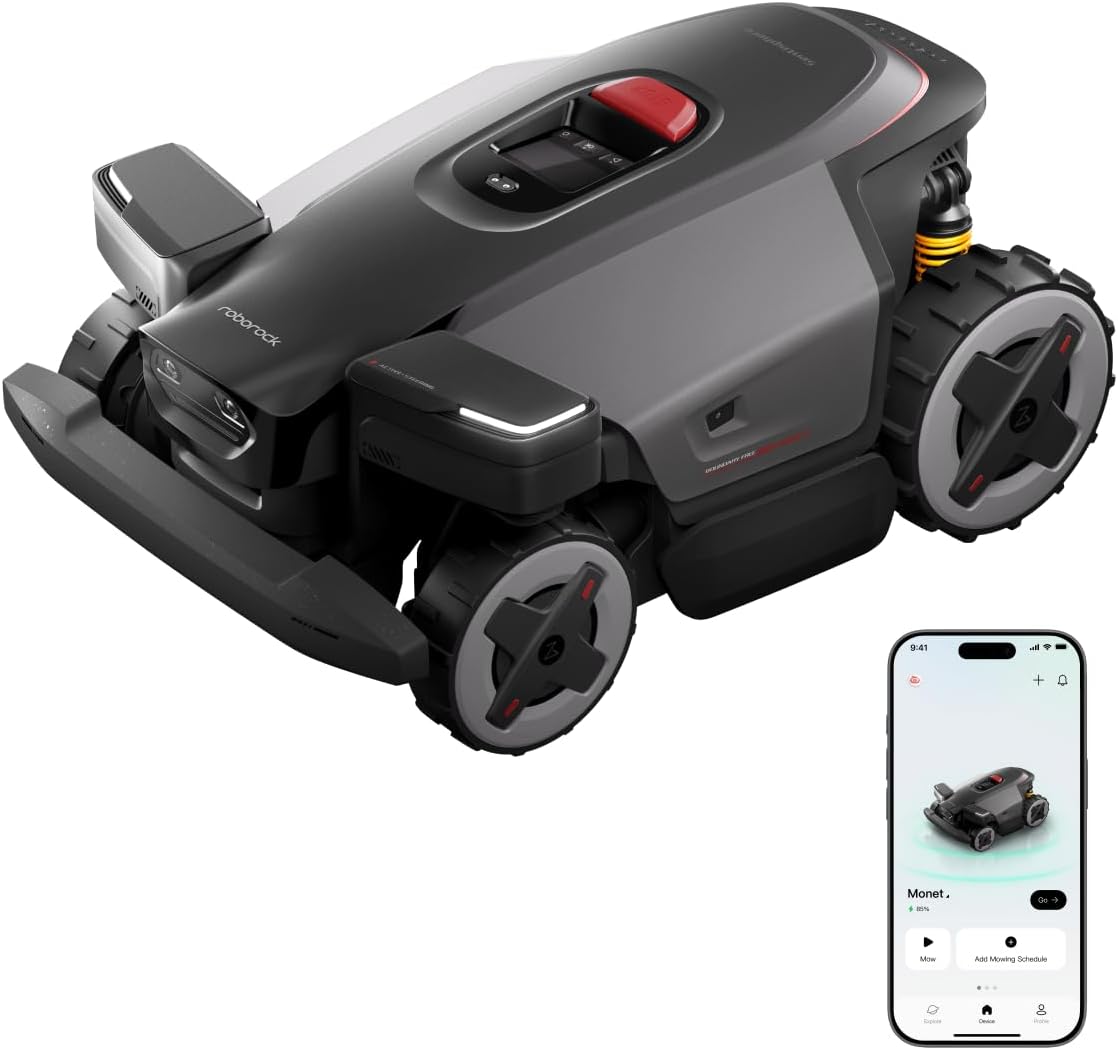
roborock RockMow X115H Robot Lawn Mower, Wire-Free 4WD, RTK and Quad-Vision
4WD, full-band RTK plus quad-vision, auto mapping, and 0.37 acre is right in the suburban sweet spot
The 80 percent slope figure is still a claim, and the premium position asks for a premium commitment
Prices and availability were captured from Amazon Creators API and may change.
What I check before anything else
On install day I care about three things, in this order: how the mower knows its boundary, where the docking station gets power and shade, and how much of my afternoon the setup eats. Everything else is a feature.
Two of these four are wire-free, which means they navigate with RTK positioning plus cameras rather than a buried perimeter loop. One, the YARDCARE, ships with a magnetic stripe. One, the V3, appears to be vision-led. That single difference changes your entire spring. A perimeter wire is two to four hours of staking and trenching for a normal suburban lot, plus the risk of a corroded splice in year two. A wire-free mower trades that work for a sky-view problem: RTK needs a clean look at the satellites, and a mature maple canopy is a genuine obstacle. I have watched RTK mowers wander at the property line under dense cover, and I have watched wired mowers run for six seasons without a thought. Wire is boring. Wire works.
I have not put these four specific machines through a Minnesota season, so treat what follows as an install-and-spec read from someone who has done this a lot, not a lab report.
The entry point: V3 AI Vision
The V3 is the smallest commitment here. It is listed at 1,600 square feet, which in my world is a courtyard, a townhouse side yard, or a fenced city lot. My front yard alone is bigger than that, so if you are picturing a half-acre, stop now.
Nothing in the spec sheet mentions a perimeter wire or an RTK antenna, which tells me the navigation is camera-led. That is genuinely appealing for a small, cluttered, obstacle-heavy yard where burying a loop would be miserable: raised beds, a shed, a fire pit, a fence line. Vision navigation does not care about any of that as long as the machine can see where it is going.
Two things I would verify before buying. First, there is no published slope rating, and a camera-led mower on a wet grade is exactly where I would expect trouble. Second, blade and part availability for a less established brand is the hidden cost nobody puts on the box. Ask about both.
The value pick: YARDCARE M800Plus
This is the interesting one, because of what is in the box. GPS plus 3D vision navigation, a bow-shaped mowing pattern, obstacle avoidance, auto-charging, app control, and up to 8,611 square feet of coverage. That coverage figure is real property, not a courtyard.
Then there is the magnetic stripe. Thirty-two point eight feet of it. Here is the arithmetic that matters: an 8,611 square foot lawn, if it were roughly square, would be about 93 feet on a side, which is somewhere around 370 feet of perimeter. So 32.8 feet of stripe is not a boundary. It is a tool. It is enough to mark a no-go line along a foundation planting bed, or to guide the mower through a narrow gap between a fence and a garage. Treat the stripe as a helper, not an install plan, and the GPS plus vision stack carries the actual navigation.
The gap in the spec sheet is cutting height. If you have tall fescue in June, the top of the cutting height range matters more than almost any other number on the page. Ask before you buy. And because GPS is doing the heavy lifting, walk your property on a cloudy day and look up: if the sky is half canopy, budget for a rough spring.
The big-property pick: Lymow One Plus
The Lymow One Plus is built for the property I get called about most: an acre and a half, a hill, a rough edge, and grass that goes from dormant to shin-high in eight days. The numbers are serious. Wire-free RTK plus vision navigation. 1.73 acres of daily coverage. All-wheel drive. A cutting height range of 1.2 inches to 4 inches.
That 4-inch top end is the spec I would frame. Most robot mowers top out around 3 inches, which is fine for a manicured lawn and useless the week after a wet May. Being able to raise the deck and take a real pass at tall grass is the difference between a mower that keeps up and a mower that leaves windrows.
The slope claim is 100 percent, which is 45 degrees. I want to be precise about what that means. A slope rating is measured on a dry surface, straight up the fall line, with a full battery. Real slopes are wet, and you often mow them across the face rather than straight up. A 45-degree capability figure tells me the machine has the traction hardware to try. It does not tell me it will hold a wet side hill in April, and neither does any other brand's number. All-wheel drive plus RTK plus vision is the right hardware combination for that property. Verify the hill yourself, in the rain, before you commit.
The premium pick: roborock RockMow X115H
If you have a normal suburban lot with a couple of obstacles and one annoying slope, this is the machine I would start with. Four-wheel drive. Wire-free navigation with full-band RTK plus quad-vision. Auto mapping. Multi-sensor AI obstacle avoidance. An 80 percent slope rating. Coverage up to 0.37 acre.
Two things stand out. First, the navigation stack is the most redundant here: RTK for position, four cameras for the world immediately in front of it, sensors for the things cameras miss. Redundancy is what saves you when a maple tree eats the satellite signal for a thirty-foot stretch of lawn. Second, 0.37 acre is exactly the size of lot where a robot mower makes sense and a wired install is annoying but not impossible. That is the suburban sweet spot, and this machine is aimed straight at it.
The 80 percent slope figure is still a claim, and I treat all of them the same way. The other consideration is app maturity. roborock has shipped consumer robotics apps for years, which is a reasonable reason to expect a more finished scheduling and mapping experience than a first-time brand can offer. I would still ask how the map behaves after a firmware update, because that is the single most common complaint I hear from owners of every brand.
Slope ratings are marketing until proven otherwise
I have watched a mower rated for a 25 percent slope slide sideways on wet grass at 18 percent. That is not a knock on any one brand. It is how the numbers are generated: dry turf, fresh blades, a straight line, a charged battery. Your lawn is none of those things in April.
So when you read 80 percent or 100 percent, translate it into three questions. What surface was that measured on? Was it straight up the fall line or across the face? And what happens when the grass is wet? If a seller cannot answer those, the number is decoration.
Cutting height and mulching matter more than top speed
Mowing frequency beats mower quality. A modest robot running daily on a 2.5-inch cut will out-mow a premium machine that runs weekly, every single time. That is why the cutting height range on these machines is the spec I linger on. The Lymow's 1.2 to 4 inch range gives you room to raise the deck during a growth surge. The V3 and YARDCARE listings do not publish a range, and that is worth a question before you buy.
Blades are the hidden cost of ownership. Dull blades tear grass instead of cutting it, and torn tips brown out and invite disease. Ask how the blades come off and whether you need a special tool. A blade change that takes ninety seconds gets done. One that takes a screwdriver hunt does not.
The app is a feature, not the mower
Every one of these machines is app-controlled, and every one of them will eventually lose its map after a firmware update, refuse to dock in the dark, or forget a schedule. That is not pessimism, it is a pattern across the category. Judge the mower on its navigation hardware and its cutting deck. Judge the app on how quickly the brand ships fixes.
Which one for which lawn
For a fenced city lot or a courtyard under 1,600 square feet, the V3 AI Vision is the sensible, low-commitment choice. You are not paying for capability you cannot use.
For a quarter- to half-acre lot with an open sky and a budget that stops short of premium, the YARDCARE M800Plus covers the most ground per dollar in this group, as long as you accept that the magnetic stripe is a helper and GPS is the actual boundary.
For an acre-plus property with real slopes and tall spring grass, the Lymow One Plus has the coverage, the all-wheel drive, and the cutting height range to handle it.
For a 0.25- to 0.37-acre suburban yard with obstacles, a hill, and tree cover you cannot avoid, the roborock RockMow X115H has the most forgiving navigation stack, and that is the spec that decides whether a mower finishes the season or spends it stuck against a fence.
Bottom line
A robot mower is a lawn system, not an appliance, and the install is the product. Decide first how the machine will know its boundary, then check whether your sky is open enough for RTK, then measure your actual lawn instead of guessing. Do that, and any of these four will do right by you. Skip it, and you will be the person on the forum in July asking why the mower keeps wandering into the mulch.