Related: How to Map a Lawn Before You Buy a Wire-Free Mower
I have installed more than thirty robot mowers for clients around the Twin Cities, and I have run one of my own through two full Minnesota seasons. In that time the questions have changed. Nobody asks me whether a robot mower works anymore. They ask whether wire-free robot lawn mowers work, because the install is the part that scares people off, and the wire is the part of the install that hurts.
Here is what I say before we talk about brands. A robot mower is a lawn system, not an appliance. The install is the product, and the mower is just the robot that executes it. A mediocre mower on a well-planned lawn beats a great mower on a lawn nobody thought about. That is true whether the boundary is a wire buried in the turf or a signal from the sky.
This guide covers four mowers in one class: three WORX models sold with no perimeter wire, and the Mammotion LUBA 3 AWD 1500H, which sits at the top of the group. I have not run these four specific units through a Minnesota winter, and I am not going to pretend otherwise. What I can do is tell you how I would choose between them, what a coverage rating really means once a house and a driveway take their cut, and which yard each one belongs on.
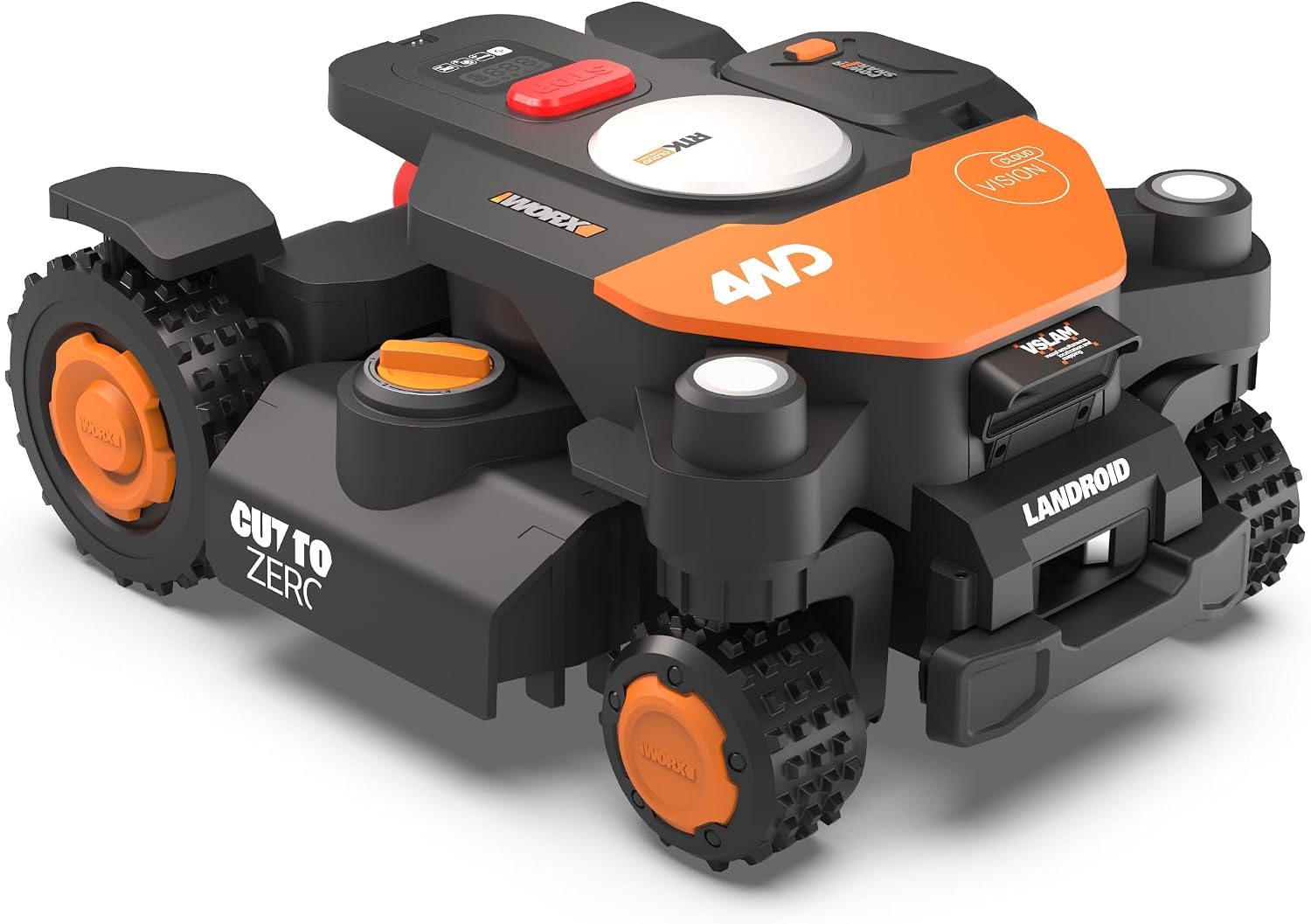
Best for Half-Acre Yards: WORX WR342 4WD
Most suburban lots in Minneapolis and St. Paul are not an acre. They are a third of an acre, or a half, and a good chunk of that is house, driveway, patio, shed, and beds. When a mower is rated for half an acre, that rating is for half an acre of grass, and the machine has to find and cover every square foot of it on a schedule. That is a different job than it sounds like.
Four-wheel drive is the reason I would start here on a lot with any kind of grade. Slope ratings on the box are marketing. I have watched a mower advertised at a 25 percent slope slide sideways on wet grass at 18 percent, in front of a client, on install day. Traction is what actually keeps a mower on a hill, and four driven wheels is the cheapest insurance you can buy against that afternoon.
No perimeter wire means no trenching, no splices, and no splice corrosion in season two, which is the failure I get called about more than any other. If you have ever dug a dead boundary wire out of frozen ground in November, you know exactly why that matters. Check current Amazon price and compare it against the one-acre model before you decide, because the gap between them is smaller than most people expect.
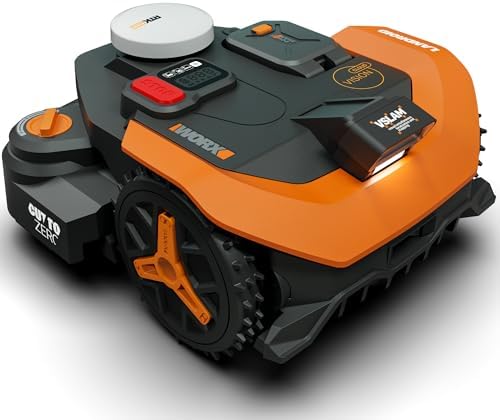
Best for Most One-Acre Lawns: WORX WR340
Twice the coverage of the half-acre model, without four-wheel drive. That is the whole trade, and it is worth understanding before you spend anything. If your acre is flat, open, and mostly grass, this is the sensible buy in the group.
I will be blunt about the catch. An acre is a lot of ground for a robot to cover daily, and coverage ratings assume the mower runs every day. Mowing frequency beats mower quality, every time. A cheap mower running daily beats an expensive one running weekly, and a one-acre machine running twice a week will leave you staring at stripes of tall grass you have to deal with yourself. Set the schedule and then leave it alone.
The second catch is terrain. Without four-wheel drive, wet spring grass is the enemy. Minnesota gets a week every April where the lawn goes from brown to four inches overnight, and that is exactly when the ground is softest. On flat ground that is fine. On any grade, it is not, and no app setting fixes it.
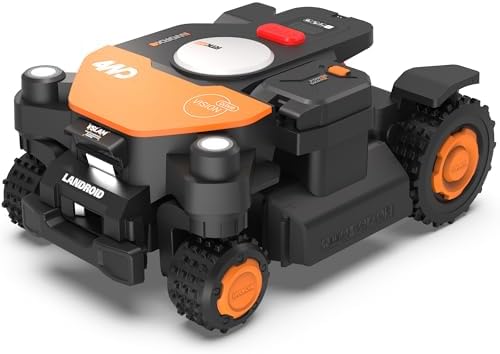
Best for Slopes and Rough Terrain: WORX WR344 4WD
This is the one I would put on a client's lot if the lot has a full acre of grass and a hill in it. Four-wheel drive and one-acre coverage in the same machine, sold without a perimeter wire. On a property with a walkout basement, a berm, or a ditch line, that combination is the difference between a mower that finishes the job and one that parks itself and sends a notification you will learn to ignore.
My honest read on drive systems: they help most in the two months a year when the ground is soft and the grass is growing fastest, which happens to be the two months when mowing matters most. The rest of the season you will not notice the extra wheels. That does not make them a waste. It makes them insurance you use in April and May and forget about in July.
If you are comparing this against the one-acre model without four-wheel drive, the question is simple. Flat acre, save the money. Acre with any slope at all, buy the traction. Check current Amazon price and let your own yard decide, not the spec sheet.
Best for Big, Complicated Properties: Mammotion LUBA 3 AWD 1500H
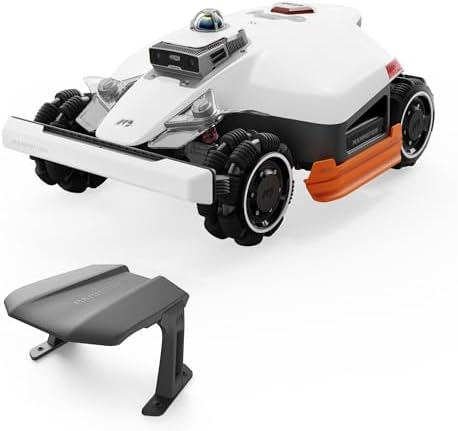
The LUBA 3 AWD 1500H is the premium end of this group, and the name tells you most of what you need to know. All-wheel drive. The highest coverage class here. And a garage that ships separately, which is a bigger deal than it sounds.
All-wheel drive on a robot mower is not a marketing word the way a slope rating is. Every wheel driven means the machine keeps traction on wet turf, on a grade, and on a lawn with a few ruts in it from a truck that should not have been parked there. If your property has more than one grade change, or a slope you mow diagonally because mowing straight up it feels wrong, this is the class of machine built for it.
The garage is a real feature, not a gimmick, provided you plan where it goes. A docking station sitting in the open collects leaves, holds snow through a Minnesota winter, and gives the mower one more thing to find in the dark. A covered dock solves the leaf problem and most of the snow problem. It ships separately, so budget for it and pick a spot with power nearby before the mower arrives.
What you are paying for is capability, and capability only pays off if your lawn needs it. On a flat half acre this mower is overkill, and you will never use half of what it does. On a wooded lot with a grade, a long driveway edge, and more than one zone, it is the one in this group I would want.
How I judge a wire-free mower
Everything below comes from how I evaluate machines for clients, not from a lab bench. Four things decide whether a robot mower is still working in year three.
Coverage, honestly counted. Measure your actual grass, not your lot. Subtract the house, the driveway, the patio, the shed, the beds, and the strip along the fence you never mow anyway. Most people I meet have thirty percent less lawn than they think they do, and that number decides which model in this guide you should be looking at.
Traction on wet grass. This is the one that decides whether a mower finishes a season. I walk a property and look for the spots where water sits after rain, because that is where a two-wheel-drive mower gives up and calls for help.
The install, including the parts nobody mentions. If there is no perimeter wire, you are not digging and you are not splicing, and that removes the single most common failure I get called about. If there is a wire, the splices are where it dies, usually in season two, usually in a spot you cannot find.
The app and the schedule. The app is a feature, not the mower. If scheduling fails, the robot is a very slow Roomba. A mower that cannot find its dock in the dark is a mower you will find sitting in the middle of your lawn at seven in the morning.
What the specs actually mean
Coverage ratings are the number that matters most and the one people misread. A one-acre mower does not mow an acre in an hour. It mows an acre across a day, with charging breaks, and it does the job best when it runs every day. Plan for daily runs and the coverage number becomes honest.
Drive systems come second. Two driven wheels are fine on flat ground. Four-wheel drive and all-wheel drive are for grade, mud, and wet grass. In fifteen years of installing lawns and reviewing mowers, I have never once heard a client complain that their mower had too much traction.
Wire-free navigation has its own cost, and I will not pretend otherwise. A boundary wire is boring and it works. A mower without one has to know where it is, and anything that depends on a signal can struggle under dense tree cover. If your lawn is ringed with mature maples, ask hard questions before you buy, because that is the failure mode nobody puts on the box.
Blade life is the hidden cost in every robot mower. Dull blades tear grass instead of cutting it, and torn tips brown off, which is how people end up blaming the mower for a lawn problem. Check what replacement blades cost and how hard they are to change before you commit, not after.
The wire-free robot mower comparison table
This is how the four stack up on the things that decide an install. Where something is not clear from the product listing, I have written See product rather than guess at it.
| Product | Cutting area | Drive | Perimeter wire | Notes |
|---|---|---|---|---|
 Visit on Amazon → WORX WR340 |
1 acre | See product | None required | Best value on flat acreage |
 Visit on Amazon → WORX WR342 4WD |
1/2 acre | 4WD | None required | Best for smaller lots with grade |
 Visit on Amazon → WORX WR344 4WD |
1 acre | 4WD | None required | Best all-rounder for acre plus slope |
 Visit on Amazon → Mammotion LUBA 3 AWD 1500H |
See product | AWD | See product | Garage ships separately |
The pattern in that table is simple. Coverage decides your model, and drive decides your season. The half-acre machine with four-wheel drive and the one-acre machine with four-wheel drive are the two I recommend most often, because most lots have a grade somewhere and most lawns are smaller than the owner believes.
The garage question
A docking station is where your mower lives for ten years, and it is the part of the install people plan last. On a property with trees, an uncovered dock collects leaves all fall and holds snow all winter. If you go with the Mammotion, the garage ships separately, so decide early whether you want it, and pick a spot with power and a little shelter from the prevailing wind.
Should you buy the WORX WR342 4WD?
Yes, if your real grass is a half acre or less and your lot has any grade to it. Four-wheel drive on a half-acre machine is the combination most suburban lots actually need, and the smaller coverage class keeps the machine honest about how long a run takes. Check current Amazon price and compare it against the one-acre model. Visit on Amazon →.
Should you buy the WORX WR340?
Yes, if your acre is flat and open. It covers twice the ground of the half-acre model and it skips the perimeter wire, which means no trenching, no splices, and no November wire repair. What it does not give you is four-wheel drive. If your property has a hill that stays soft in spring, spend the difference on the four-wheel-drive model instead. Visit on Amazon →.
Should you buy the WORX WR344 4WD?
Yes, if you have an acre of grass and a slope. Four-wheel drive plus one-acre coverage is the pairing Minnesota yards keep asking for, because the ground is soft exactly when the grass is growing fastest. The one-acre model without four-wheel drive saves you money on flat ground. This is the one that keeps working when the ground is not flat. Visit on Amazon →.
Should you buy the Mammotion LUBA 3 AWD 1500H?
Buy it if your property is genuinely complicated. All-wheel drive, the highest coverage class here, and a garage you can add to keep the dock out of the leaves and the snow. It costs the most of the four. If your lawn is simple, you are paying for capability you will never use, and a smaller WORX model will serve you just as well. Visit on Amazon →.
The short version, after thirty-plus installs: count your actual grass, then buy the smallest machine that covers it with four driven wheels. That is the decision that holds up in season three, when the novelty is gone and the mower is just the thing that keeps your lawn short while you are doing something else.