I have installed more than 30 robot mowers for clients around Minneapolis, and I keep a string-and-stakes map of every single one of them in a binder that my husband calls "the lawn bible." That binder is why this robot lawn mower comparison looks the way it does. After two full Minnesota seasons, a spring of mud, a dog that treats a moving robot as a personal insult, and the mulberry-leaf clog of 2024, I have stopped ranking mowers by how clever their marketing is and started ranking them by what happens on install day and in week eleven.
The four machines here solve four genuinely different problems. The YARBO is a wire-free modular system aimed at big properties. The YARDCARE M800Plus chases raw coverage. The Segway Navimow i206 AWD leans on all-wheel drive and a steep slope rating. The V3 AI Vision is the budget entry that has to justify itself without a wire, without RTK, and without a big number on the box. If you are shopping in the $400 to $5,000 band, you are choosing between philosophies, not between spec sheets.
The short answer: for a normal quarter-acre suburban lawn with a fence and a couple of obstacles, the Segway Navimow i206 AWD is the one I would install first, because all-wheel drive is the single feature that survives a wet Minnesota spring. The YARDCARE is the pick for anyone with real acreage, the YARBO is for the homeowner who wants modularity and has the budget and the tree-free sky to support it, and the V3 AI Vision is the honest budget option for a small, simple yard.
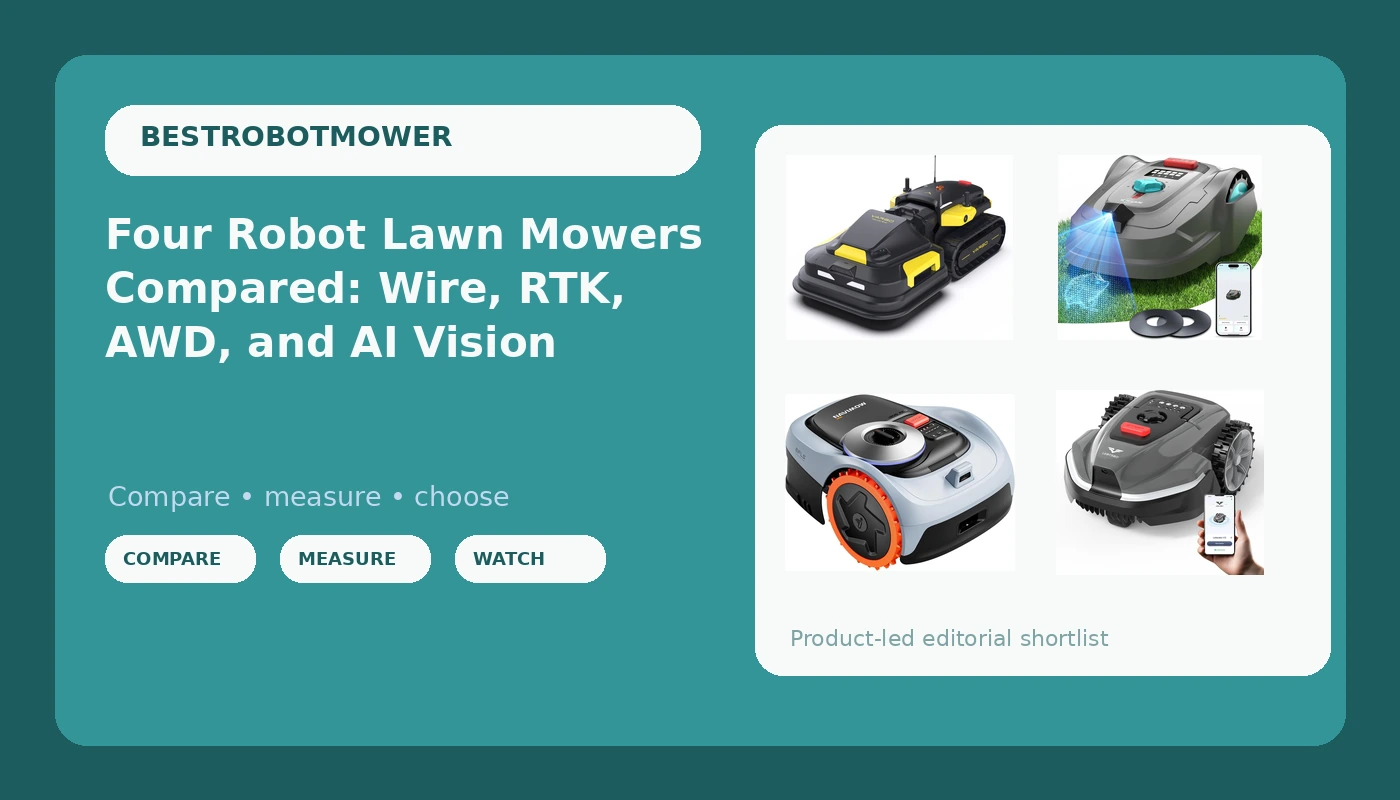
YARBO Robot Lawn Mower, Wire-Free with Modular Design, for Large Yard
Wire-free layout plus a modular body, built for large yards and for adding capability later
Highest cost here by a wide margin, and wire-free systems live or die on sky view
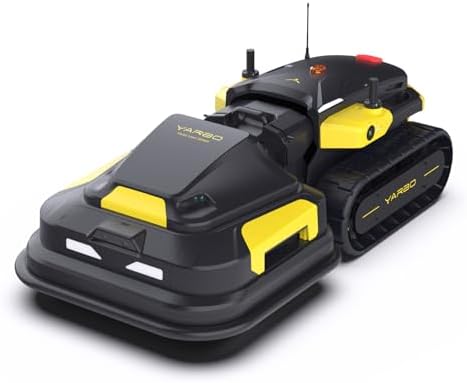
YARDCARE 2026 New M800Plus Robot Lawn Mower, 8611 sq.ft, Deep Gray
The coverage number is the story: 8,611 square feet is real acreage territory
A big claimed area usually means more dock trips, more blade wear, and a longer install
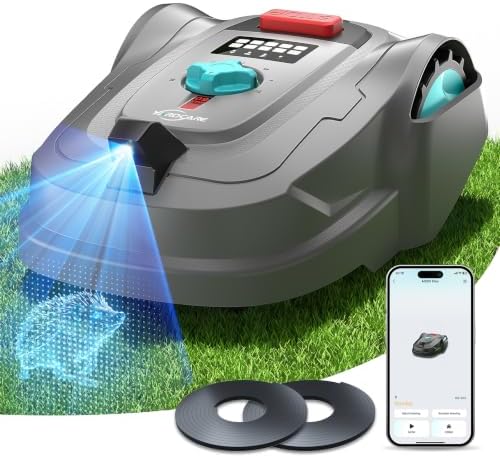
Segway Navimow i206 AWD Robot Lawn Mower, New i105N, 0.15 Acre, 45% Slopes
All-wheel drive and a 45% slope claim in a compact body for a 0.15 acre lawn
Slope ratings are marketing until the grass is wet, and this is the smallest area here
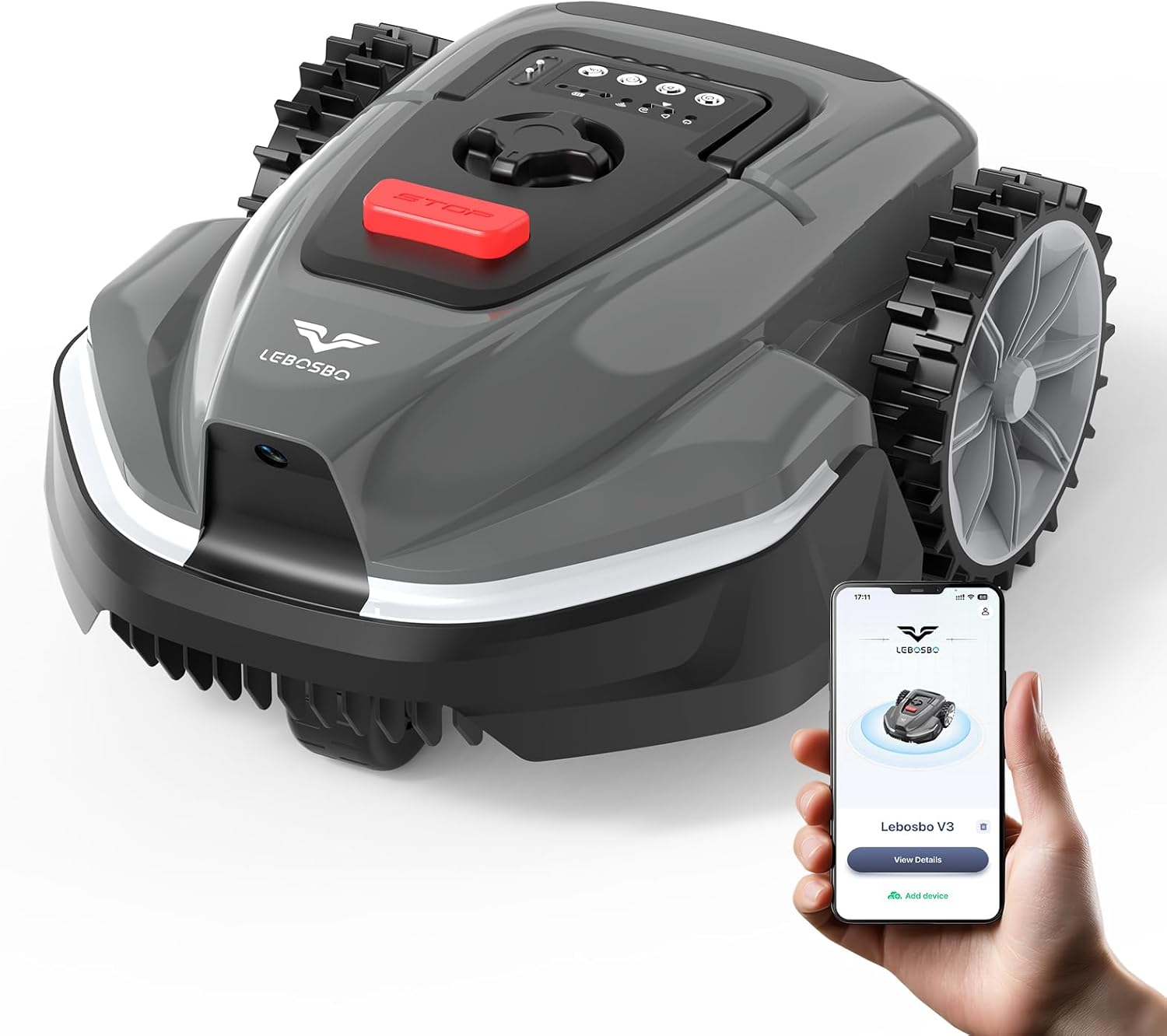
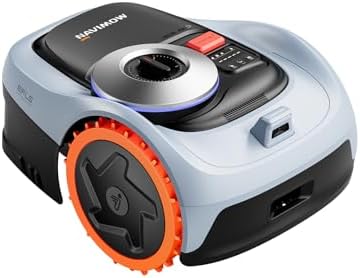
V3 AI Vision Robotic Lawn Mower, 1600 Sq.Ft, Dark Grey
AI vision navigation at the lowest entry point in this group
1,600 square feet is a small yard, and vision navigation has its own weak spots
Prices and availability were captured from Amazon Creators API and may change.
How I read a robot mower listing
A robot mower is a lawn system, not an appliance. The install is the product. The robot is just the part that executes it. So when I read a listing, I skip the adjectives and look for four things: how the machine knows where it is, how much lawn it claims to cover, how it handles slope, and what happens when it loses its mind at 9 p.m. and has to find the dock in the dark.
Positioning is the first fork in the road. Wire-free sounds like freedom, and for a lot of yards it is. But wire-free almost always means RTK, which means satellite correction, which means your mower needs a clear view of the sky. My own 0.4 acre has a maple canopy that eats GPS for breakfast. I install wire for clients who want reliability and RTK for clients who have open sky and hate the idea of a blade buried in their perennial bed. Both are defensible. Neither is universal.
Coverage is the second fork. Claimed square footage is a daily-run number, not a "mow the whole thing in one charge" number. A mower rated for 8,611 square feet is telling you it can keep up with that lawn when it runs on a schedule. It is not telling you it finishes before lunch.
Slope is the third fork, and the one I trust least. I have watched a mower with a "25% slope" rating slide sideways on wet grass at 18%. Traction, not motor torque, is what saves you. That is why the AWD label on the Segway matters more to me than its percentage.
YARBO: the modular, wire-free outlier
The YARBO Robot Lawn Mower is the one that makes clients lean forward when I describe it. Wire-free with a modular design, sized for a large yard. Modular is the interesting word. It implies you are buying a platform, not a finished appliance, and that you can grow into it rather than replace it.
Wire-free layout is a genuine install-day win. No trenching, no stakes, no splice that corrodes by August. If you have ever helped bury 400 feet of perimeter wire around a garden bed, you understand why people pay for this. The trade-off is that wire-free is not the same as carefree. You still need a clear sky view, you still need a dock with power, and you still need a boundary plan for beds, the dog, and the trampoline.
Cost is the honest objection. This is the highest-priced machine in this comparison, and it is aimed at properties where the alternative is a riding mower or a lawn service contract. If you have a half acre or more and you want to add capability over time, the math can work. If you have a quarter acre and a maple, I would not spend here. You can Visit on Amazon → before you decide, but go in knowing that the install is the cheap part.
YARDCARE M800Plus: coverage for people with real acreage
The YARDCARE 2026 New M800Plus Robot Lawn Mower lists 8,611 square feet, which is the kind of number that makes a rural homeowner stop scrolling. That is a fifth of an acre of continuous cutting, and it is the largest claimed area in this group by a wide margin.
Here is what that number means in practice. Big coverage claims come with three hidden bills. First, blade wear. More square footage means more cutting hours, and cheap blades dull in about a month. When blades dull, the robot starts tearing grass instead of cutting it, and you get brown tips along every pass. Second, dock trips. A larger lawn means more returns to charge, and every return is a chance for the mower to wander. Third, the install itself. You are either staking a long perimeter or planning a large wire-free boundary, and either way it is a weekend, not an afternoon.
The deep gray finish is a small thing that matters more than people expect. Light-colored mowers show grass stain and look tired by July. If you have a big lawn and you want one machine to own it, this is the row in the table to look at. Just budget for blades the way you budget for gas in a car.
Segway Navimow i206 AWD: slope traction without drama
The Segway Navimow i206 AWD Robot Lawn Mower is the one I would put on most suburban lots. It lists a 0.15 acre lawn, which is about 6,500 square feet, and it lists 45% slopes with all-wheel drive. The AWD part is what I care about.
Slope ratings are tested on dry turf, usually by people who have never carried a wet golden retriever up a hill. What actually determines whether a mower holds a line is whether all four wheels are driving or just two. Two-wheel-drive mowers on a wet grade do a slow sideways slide that looks harmless until it tears a stripe in the turf along the bed edge. All-wheel drive fixes the physics, not the marketing. If your yard has any grade at all, and you live somewhere with actual weather, this is the feature that keeps the machine useful in April and October instead of just July.
The size is the honest limitation. At roughly 6,500 square feet of claimed coverage, this is a lawn that takes a while to finish, and it will not suit a property with a big back field. The "New i105N" designation in the name is worth checking against the listing so you know exactly which revision you are buying. For a fenced quarter acre with a slope behind the garage, this is the machine I would install first.
V3 AI Vision: the budget entry point
The V3 AI Vision Robotic Lawn Mower is the dark horse. It lists 1,600 square feet, which is a small, simple yard, and it navigates with AI vision rather than a buried wire or a satellite fix. That is a real advantage in one specific situation: a shaded yard where RTK struggles, because vision does not need an open sky.
Vision navigation has its own failure modes, and I want you to know them before you buy. Low sun can blind a camera. A yard that changes every week, with a hose left out or a pile of leaves, is harder for a vision system than for a wire boundary. And heavy mulch beds that blend into turf are exactly the kind of edge case where a camera-based mower gets confused. That is not a knock on this machine. It is a knock on buying one without walking your yard first and asking where the machine will get disoriented.
What it does well is the entry point. This is the lowest-cost way into a real robot mower in this comparison, and 1,600 square feet covers a lot of city lots. If your yard is small, flat, and mostly open, and you want to stop pushing a mower on Saturday mornings, this is where I would start.
The hidden costs nobody quotes you
Nobody sells you the system. They sell you the robot. So here is the part of the install that does not show up in the listing.
Perimeter wire is the real cost of the wired approach. It is cheap per foot and expensive per weekend. Splices corrode, stakes pull up in a frost heave, and a single nick from an edger takes the whole loop down. If you go wire-free, you trade that for a dock placement puzzle and a dependence on sky view.
Blades are the other recurring bill. A robot mower cuts with tiny razor blades that need replacing regularly, and the frequency depends entirely on how much lawn you have. The YARDCARE's 8,611 square feet will chew through blades faster than the V3's 1,600. Buy spares up front. Blades that need a special tool to swap are a design failure in my book.
The dock deserves a paragraph of its own. A mower that cannot find its dock in the dark is a mower you will find in the middle of the lawn at 6 a.m. Put the dock somewhere with a clear approach, on level ground, with power, and not under the one tree that drops everything.
And the app is a feature, not the mower. If scheduling fails after a firmware update, you own a very slow Roomba. I have seen maps vanish after updates on machines that cost more than my first car. Read the app reviews before you read the mower reviews.
What I would install, and on which lawn
For a fenced quarter acre with a slope, the Segway Navimow i206 AWD. All-wheel drive is the feature that keeps working when the grass is wet and the season is long.
For a large property where install day is the main obstacle, the YARBO Robot Lawn Mower, provided you have open sky and the budget for a platform rather than an appliance.
For acreage and a coverage number that means something, the YARDCARE 2026 New M800Plus, with a blade budget and a realistic install weekend.
For a small, simple, shaded city lot, the V3 AI Vision Robotic Lawn Mower, at the lowest entry price in this group.
Mowing frequency beats mower quality, every time. A cheap robot running daily beats an expensive one running weekly, because daily cutting keeps clippings short enough to mulch back into the turf instead of smothering it. Whichever row you pick, run it every day.
What I am watching next
I predict the market settles on hybrid navigation, wire plus RTK, because pure RTK keeps failing under tree cover and pure vision keeps struggling with changing yards. Watch the blade war next. Self-sharpening blades will be the premium tier within two years, and the first brand to make them genuinely work will own the replacement revenue for a decade. I also expect real mowers to fall below $1,000 within three years as the factories scale, which is good news for anyone who has been waiting on the fence.
I will be scoring those predictions in January, the same way I do every year, with the binder open and the string map on the table.