
Anyone shopping for a wire-free robot lawn mower runs into the same wall. The mower is the easy part to compare. The install is the part that decides whether the thing ever works. Laying a perimeter wire is not difficult, but it is a weekend of stakes, splices, and a shovel, and every splice is a future corrosion point in a wet climate. That is why wire-free models get so much attention, and why the marketing around them deserves a hard look before you buy.
This guide compares six entries drawn from the same catalog feed: one wire-free machine that maps with LiDAR and vision, one RTK and vision model for smaller lawns, three WORX models covering half an acre up to a full acre, and one entry that is not a mower at all. That last one is listed here because it appeared in the same feed, and hiding it would make the grid dishonest. Everything below sticks to what the product listings actually state: coverage, navigation method, cutting height, slope rating, and connectivity.
Related: Planning a Perimeter Wire Layout Before You Give Up on It
Quick answer
The MOVA LiDAX Ultra 2000 Robot Lawn Mower with 4G for 0.5 Acre, No Wire No RTK+360° 3D LiDAR+AI Vision Auto Mapping, Zero-Edge Cutting, Cut Height 1.2"-3.9", 45% Slope, 150 Mowing Zones, Anti-Theft is the strongest fit for a lawn up to half an acre with genuine slope and tree cover, because it maps with 360 degree 3D LiDAR and AI vision instead of leaning on RTK correction, and it carries a 45% slope rating with zero-edge cutting. Choose the ECOVACS Goat O1000 RTK Robot Lawn Mower instead when the lawn is a quarter acre or less and you want RTK plus vision navigation in a smaller package.
Robot lawn mowers worth comparing
The grid below is ordered with the strongest all-round fit first. Coverage area, navigation method, and slope handling are the three numbers that separate these machines, so those are the ones I pulled to the front.
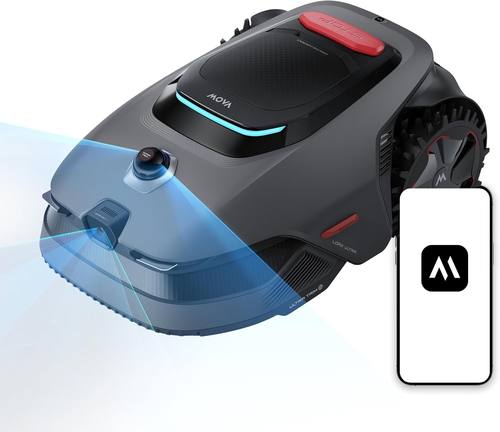
MOVA LiDAX Ultra 2000 Robot Lawn Mower with 4G for 0.5 Acre, No Wire No RTK+360° 3D LiDAR+AI Vision Auto Mapping, Zero-Edge Cutting, Cut Height 1.2"-3.9", 45% Slope, 150 Mowing Zones, Anti-Theft
A wire-free, RTK-free design sized for lawns up to 0.5 acre. It maps with 360 degree 3D LiDAR and AI vision, cuts to a zero edge, offers a 1.2 inch to 3.9 inch cutting height range, carries a 45% slope rating, supports up to 150 mowing zones, includes 4G connectivity, and lists anti-theft features.
Visit on Amazon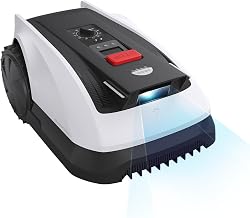
ECOVACS Goat O1000 RTK Robot Lawn Mower, Wire-Free Robotic Lawnmower for Up to 1/4 Acre, RTK + Vision Navigation, Auto Mapping, TruEdge Edge Cutting, AIVI 3D Obstacle Avoidance, APP Control
A wire-free mower for lawns up to 1/4 acre. It pairs RTK positioning with vision navigation, handles its own mapping, uses TruEdge edge cutting, adds AIVI 3D obstacle avoidance, and is controlled through an app.
Visit on Amazon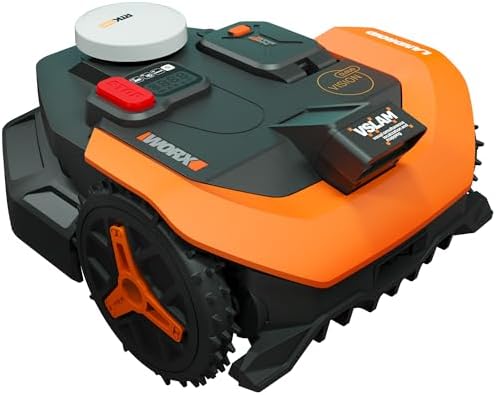
WORX Robot Lawn Mower for 1/2 Acre, No Perimeter Wire, WR320
The half-acre option in the WORX lineup, and one of the three models here that the listing describes as needing no perimeter wire.
Visit on Amazon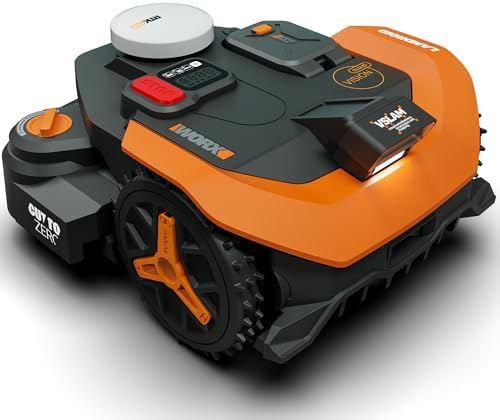
WORX Robot Lawn Mower for 1 Acre, No Perimeter Wire, WR340
A no-perimeter-wire WORX model sized for a full acre, which puts it a step above the half-acre machine in coverage.
Visit on Amazon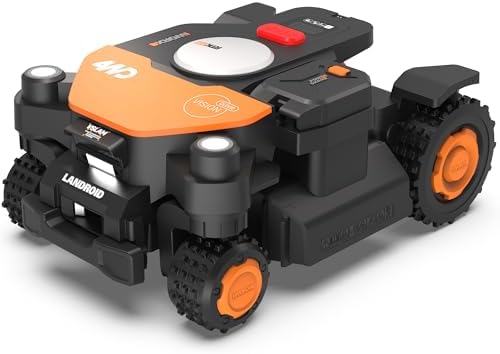
WORX Robot Lawn Mower 4WD for 1 Acre, No Perimeter Wire, WR344
The four-wheel-drive entry in the WORX group, sized for a full acre with no perimeter wire. Four driven wheels are the relevant difference here, since traction is what decides whether a robot holds a line on a wet slope.
Visit on Amazon
How Lucky Am I
Not a robot lawn mower, and it has no mowing specifications to compare. It appeared in the same catalog feed under this title and is listed here so the grid matches the source data rather than quietly dropping it.
Visit on AmazonPrices and availability may change. Check the retailer for current details.
How these products were compared
This guide compares covered lawn area, navigation method, edge cutting behavior, slope and terrain handling, and app and connectivity features. Product names, images, and retailer links are matched by ASIN so that every card points to the product shown, and no card in the grid carries a claim that the listing does not support.
Two limits are worth stating up front. First, the specifications below come from the product listings, not from a season of use on my own lawn, so treat slope ratings and coverage figures as manufacturer claims rather than field results. Second, one entry in this feed is not a mower at all, and no amount of comparison criteria will turn it into one. It stays in the grid for completeness and gets no recommendation.
How to choose the right robot lawn mower
Start with the area you actually mow, not the size of your lot. A quarter-acre lot with a house, a driveway, a patio, and planting beds might leave 0.15 acre of grass. Coverage ratings describe turf, so measure the turf. If your mowable area lands under a quarter acre, the ECOVACS Goat O1000 is rated for that scale. If it lands between a quarter and a half acre, the MOVA LiDAX Ultra 2000 covers up to 0.5 acre, and the WORX WR320 is listed for half an acre as well. Above that, the WORX WR340 and the four-wheel-drive WORX WR344 are both listed for a full acre.
Then decide how the machine should know where the lawn ends. There are three real answers. A perimeter wire defines the boundary physically, which is boring and reliable. RTK uses satellite correction to hold a position, which is elegant until tree cover interrupts the signal, and that is the single most common complaint I hear from homeowners with mature maples. LiDAR and vision mapping builds a map from what the mower can see, which is the approach the MOVA uses and the reason it can be described as both no wire and no RTK. If you want the longer version of that argument, I wrote about how RTK behaves under tree cover after one too many clients asked why their mower stopped at the same corner every afternoon.
The third decision is edge behavior. Zero-edge cutting on the MOVA and TruEdge cutting on the ECOVACS both target the strip that older robots leave standing along foundations and bed edges. If you have a lot of straight, hard edging against concrete, that feature earns its keep. If your lawn edges are soft and planted, it matters far less.
Finally, look at cutting height range and zones. A 1.2 inch to 3.9 inch range, as listed on the MOVA, covers both a short spring cut and a taller summer cut in a northern climate. Zone support matters if you want to schedule the front and back separately, or keep the robot out of a dog run. The MOVA listing claims up to 150 zones, which is far more than a suburban yard needs but useful if you want fine control.
MOVA LiDAX Ultra 2000 Robot Lawn Mower
The MOVA LiDAX Ultra 2000 is the top pick here because it solves the two problems that break robot mowers on real properties: it needs no perimeter wire to install, and it does not depend on RTK, so tree cover is not a navigation problem in the way it is for satellite-based mowers. It is rated for lawns up to 0.5 acre, maps with 360 degree 3D LiDAR and AI vision, cuts to a zero edge, adjusts from 1.2 inches to 3.9 inches, carries a 45% slope rating, supports up to 150 mowing zones, includes 4G connectivity, and lists anti-theft features. For a half-acre lawn with a slope and a few mature trees, that combination is the most complete set of answers in this group.
The trade-off is the same one that applies to any mower without a boundary wire: the map is the boundary, so there is no physical loop sitting in the ground as a fallback if the map ever needs to be rebuilt. A wire-based machine is still the more conservative choice for a client who wants to set it and forget it for a decade. The 0.5 acre ceiling is also a hard stop. If your turf is larger than that, this machine is not the answer regardless of how good the navigation sounds.
Alternatives to consider
The ECOVACS Goat O1000 is better suited to a quarter acre or less, where RTK plus vision navigation is plenty to hold a boundary and the smaller coverage rating is not a limitation. It also brings TruEdge edge cutting and AIVI 3D obstacle avoidance, which matters on a lawn with toys, hoses, and a dog that treats moving objects as a personal challenge.
The WORX WR320 is a stronger fit when you want a half-acre machine from a brand with a long outdoor tool history and no perimeter wire to bury, while the WORX WR340 steps up to a full acre for larger properties.
The WORX WR344 and the MOVA LiDAX Ultra 2000 cover terrain and coverage at the top of this group, with the WR344 adding four-wheel drive for a full acre. The How Lucky Am I entry covers nothing in the mowing sense, since it is not a robot lawn mower and has no turf specifications at all.
Day-to-day use and maintenance
Frequency beats intensity with any of these machines. A robot running most days on a modest cut produces a denser lawn than one running weekly at a low setting, because it never takes more than a third of the blade at once. That is a mowing principle, not a product claim, and it holds whether you buy the top pick or the smallest model here.
Blades are the hidden running cost. Dull blades tear grass instead of cutting it, and torn tips brown out and invite disease. Check the blade condition monthly during the growing season and replace or sharpen as needed, and check whether your chosen model needs a special tool for the job before you buy. Dock placement deserves an hour of thought: the dock needs level ground, a nearby outlet, and a clear approach, and a robot that cannot find its dock in dim light will run itself flat. Keep the lawn clear of dog toys, fallen branches, and hose loops, since obstacle avoidance helps but is not a substitute for a five-minute walk before the season starts.
In a climate with real winter, plan the off-season. Bring the mower and dock indoors or into a dry shed, store the battery at a partial charge rather than full, and clean the underside before storage. Firmware and app updates are also worth doing before spring rather than during the first week of growth, because a mapping change mid-season is more disruptive than one in February.
Buying checklist
- Measure the turf you actually mow, not the lot size.
- Match the coverage rating to that number with a little headroom.
- Decide the navigation method: perimeter wire, RTK, or LiDAR and vision mapping.
- Check the cutting height range against how you like the lawn to look in spring and midsummer.
- Confirm the slope rating and think honestly about your wettest hill.
- Verify the dock location has level ground and power within reach.
- Check the app requirements and the return terms before ordering.
Final recommendation
Choose the MOVA LiDAX Ultra 2000 when your turf is up to half an acre, your property has slope and tree cover, and you want to skip both the perimeter wire and the RTK signal problem. It is the most capable all-round package in this group, and the zero-edge cutting and 150-zone support give you room to tune it over time.
Choose the ECOVACS Goat O1000 when your mowable area is a quarter acre or less and you want RTK plus vision navigation in a smaller machine. Choose a WORX model when coverage is the deciding factor, with the WR320 for half an acre, the WR340 for a full acre, and the four-wheel-drive WR344 when traction on a full acre is the priority. Skip the remaining entry in the grid entirely, because it is not a robot lawn mower and nothing in its listing changes that.